

726
15 Optics
Substituting θ = C, the critical angle
cos θ = cos C =
1 − sin
2 C =
1 −
1
μ 2 =
1
μ
μ 2 − 1
∴ f =
1
2
1 −
1
μ
μ 2 − 1
15.2 The momentum carried by each photon is hν/c. If it is incident normally on a
black surface, it exerts an impulse of hν/c. The total pressure exerted would
be
1
c
hν, where the summation extends over photons of all frequencies incident on the surface per unit area per second. If W is the power of the source,
then at distance r , the intensity I = W/4πr 2 . Then pressure
P =
I
c
=
W
4πr 2 c
=
1000
(4π)(2 2 )(3 × 10 8 )
= 6.63 × 10
−8 Pa
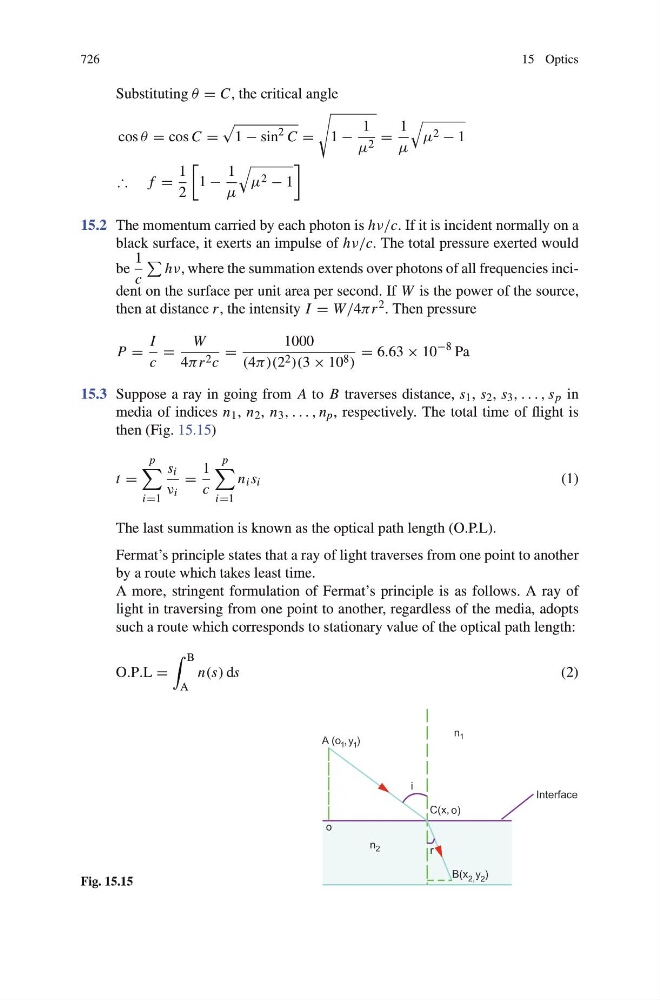
15.3 Suppose a ray in going from A to B traverses distance, s 1 , s 2 , s 3 , . . . , s p in
media of indices n 1 , n 2 , n 3 , . . . , n p , respectively. The total time of flight is
then (Fig. 15.15)
t =
p
i=1
s i
ν i
=
1
c
p
i=1
n i s i
(1)
The last summation is known as the optical path length (O.P.L).
Fermat’s principle states that a ray of light traverses from one point to another
by a route which takes least time.
A more, stringent formulation of Fermat’s principle is as follows. A ray of
light in traversing from one point to another, regardless of the media, adopts
such a route which corresponds to stationary value of the optical path length:
O.P.L =
B
A
n(s) ds
(2)
Fig. 15.15