

15.2 Problems
717
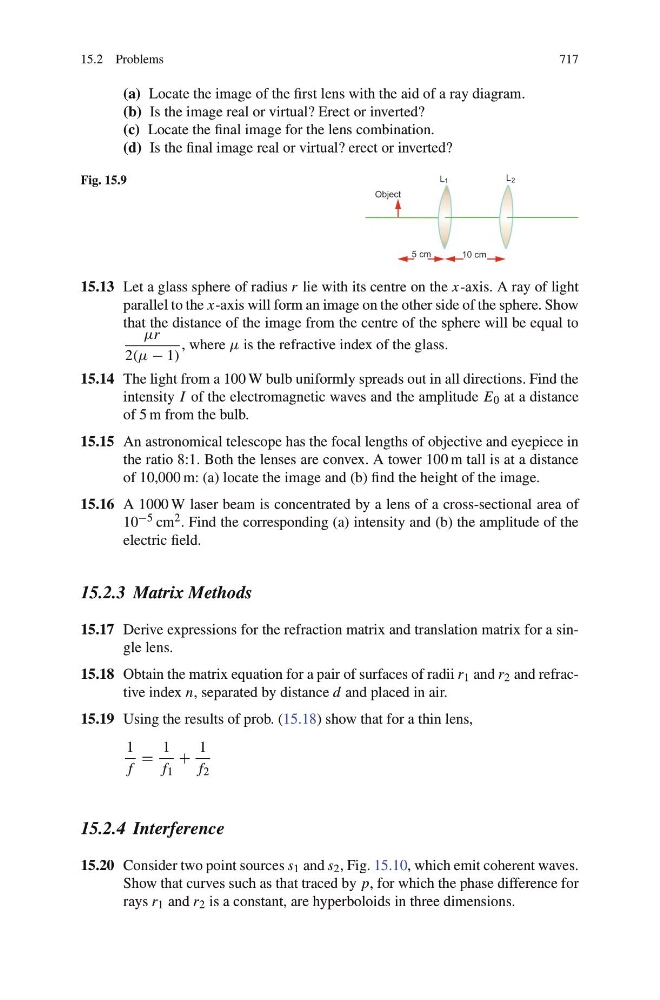
(a) Locate the image of the first lens with the aid of a ray diagram.
(b) Is the image real or virtual? Erect or inverted?
(c) Locate the final image for the lens combination.
(d) Is the final image real or virtual? erect or inverted?
Fig. 15.9
15.13 Let a glass sphere of radius r lie with its centre on the x-axis. A ray of light
parallel to the x-axis will form an image on the other side of the sphere. Show
that the distance of the image from the centre of the sphere will be equal to
μr
2(μ − 1)
, where μ is the refractive index of the glass.
15.14 The light from a 100 W bulb uniformly spreads out in all directions. Find the
intensity I of the electromagnetic waves and the amplitude E 0 at a distance
of 5 m from the bulb.
15.15 An astronomical telescope has the focal lengths of objective and eyepiece in
the ratio 8:1. Both the lenses are convex. A tower 100 m tall is at a distance
of 10,000 m: (a) locate the image and (b) find the height of the image.
15.16 A 1000 W laser beam is concentrated by a lens of a cross-sectional area of
10 −5 cm 2 . Find the corresponding (a) intensity and (b) the amplitude of the
electric field.
15.2.3 Matrix Methods
15.17 Derive expressions for the refraction matrix and translation matrix for a single lens.
15.18 Obtain the matrix equation for a pair of surfaces of radii r 1 and r 2 and refractive index n, separated by distance d and placed in air.
15.19 Using the results of prob. (15.18) show that for a thin lens,
1
f
=
1
f 1
+
1
f 2
15.2.4 Interference
15.20 Consider two point sources s 1 and s 2 , Fig. 15.10, which emit coherent waves.
Show that curves such as that traced by p, for which the phase difference for
rays r 1 and r 2 is a constant, are hyperboloids in three dimensions.