

710
15 Optics
Since both m and p are integers, d/a must be in the ratio of two integers. Thus if
order 3 is missing then d/a = 3. Other interference fringes which are missing are
6, 9, . . . .
If the ratio d/a is not exactly equal to the ratio of two integers, then the intensity
of a particular order will not be zero but would be quite small.
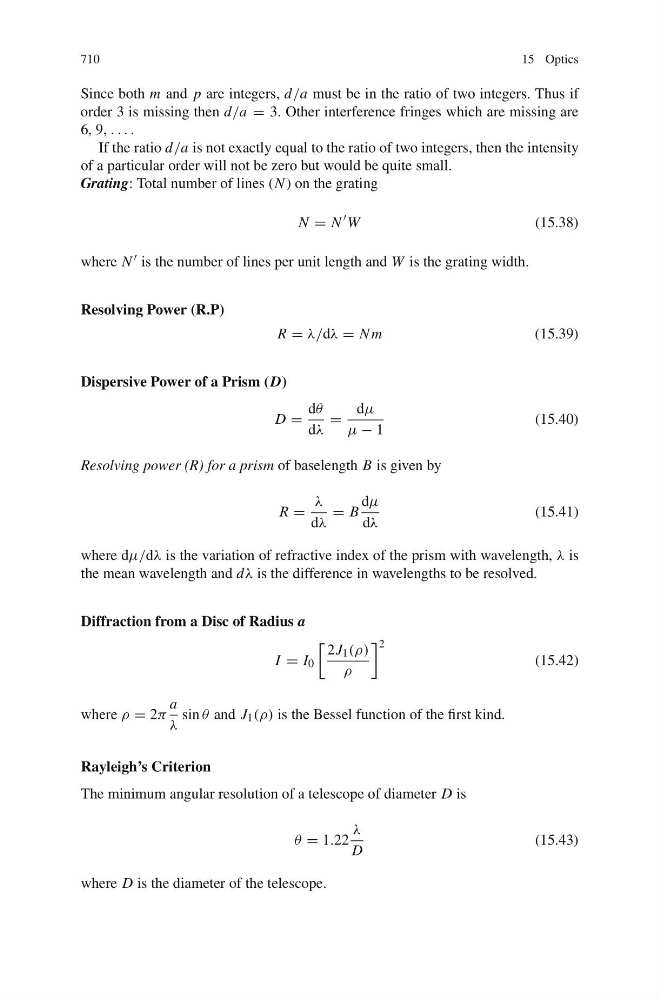
Grating: Total number of lines (N ) on the grating
N = N
W
(15.38)
where N is the number of lines per unit length and W is the grating width.
Resolving Power (R.P)
R = λ/dλ = N m
(15.39)
Dispersive Power of a Prism ( D)
D =
dθ
dλ
=
dμ
μ − 1
(15.40)
Resolving power (R) for a prism of baselength B is given by
R =
λ
dλ
= B
dμ
dλ
(15.41)
where dμ/dλ is the variation of refractive index of the prism with wavelength, λ is
the mean wavelength and dλ is the difference in wavelengths to be resolved.
Diffraction from a Disc of Radius a
I = I 0
2J 1 (ρ)
ρ
2
(15.42)
where ρ = 2π
a
λ
sin θ and J 1 (ρ) is the Bessel function of the first kind.
Rayleigh’s Criterion
The minimum angular resolution of a telescope of diameter D is
θ = 1.22
λ
D
(15.43)
where D is the diameter of the telescope.