

15.1 Basic Concepts and Formulae
705
Lens Maker’s Formula
Sign Convention
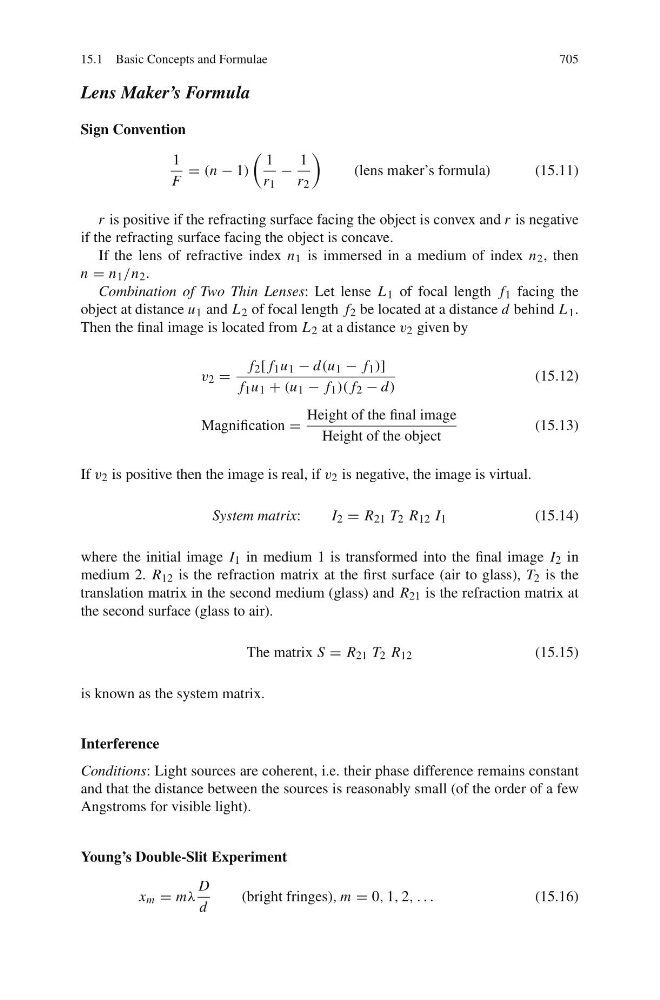
1
F
= (n − 1)
1
r 1
−
1
r 2
(lens maker’s formula)
(15.11)
r is positive if the refracting surface facing the object is convex and r is negative
if the refracting surface facing the object is concave.
If the lens of refractive index n 1 is immersed in a medium of index n 2 , then
n = n 1 /n 2 .
Combination of Two Thin Lenses: Let lense L 1 of focal length f 1 facing the
object at distance u 1 and L 2 of focal length f 2 be located at a distance d behind L 1 .
Then the final image is located from L 2 at a distance v 2 given by
v 2 =
f 2 [ f 1 u 1 − d(u 1 − f 1 )]
f 1 u 1 + (u 1 − f 1 )( f 2 − d)
(15.12)
Magnification =
Height of the final image
Height of the object
(15.13)
If v 2 is positive then the image is real, if v 2 is negative, the image is virtual.
System matrix:
I 2 = R 21 T 2 R 12 I 1
(15.14)
where the initial image I 1 in medium 1 is transformed into the final image I 2 in
medium 2. R 12 is the refraction matrix at the first surface (air to glass), T 2 is the
translation matrix in the second medium (glass) and R 21 is the refraction matrix at
the second surface (glass to air).
The matrix S = R 21 T 2 R 12
(15.15)
is known as the system matrix.
Interference
Conditions: Light sources are coherent, i.e. their phase difference remains constant
and that the distance between the sources is reasonably small (of the order of a few
Angstroms for visible light).
Young’s Double-Slit Experiment
x m = mλ
D
d
(bright fringes), m = 0, 1, 2, . . .
(15.16)