

14.3 Solutions
673
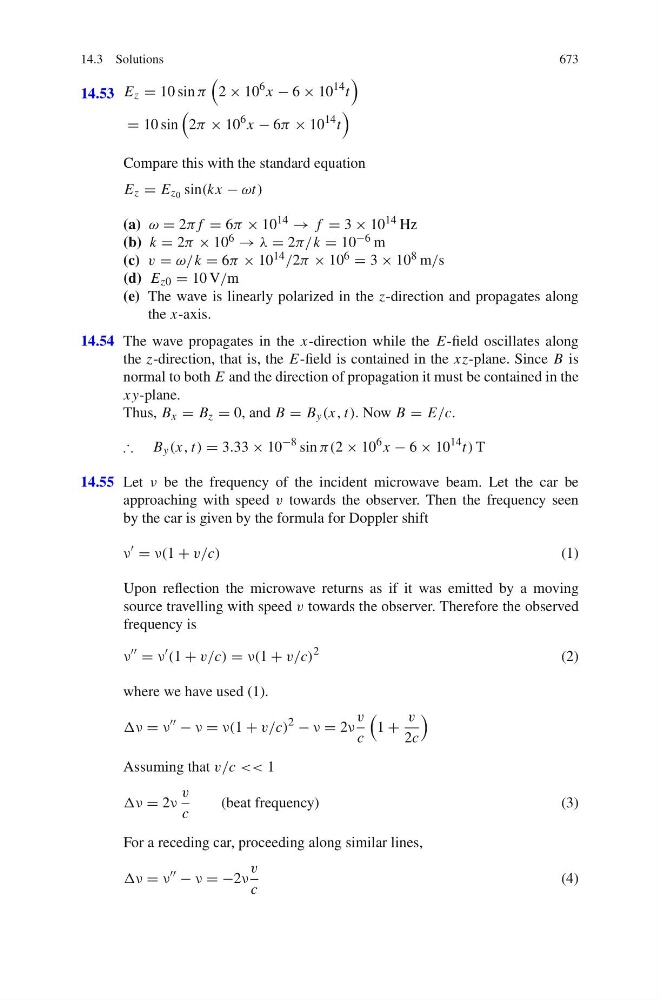
14.53 E z = 10 sin π
2 × 10
6 x − 6 × 10
14 t
= 10 sin
2π × 10
6 x − 6π × 10
14 t
Compare this with the standard equation
E z = E z 0 sin(kx − ωt)
(a) ω = 2π f = 6π × 10 14 → f = 3 × 10 14 Hz
(b) k = 2π × 10 6 → λ = 2π/k = 10 −6 m
(c) v = ω/k = 6π × 10 14 /2π × 10 6 = 3 × 10 8 m/s
(d) E z0 = 10 V/m
(e) The wave is linearly polarized in the z-direction and propagates along
the x-axis.
14.54 The wave propagates in the x-direction while the E-field oscillates along
the z-direction, that is, the E-field is contained in the xz-plane. Since B is
normal to both E and the direction of propagation it must be contained in the
x y-plane.
Thus, B x = B z = 0, and B = B y (x, t). Now B = E/c.
∴ B y (x, t) = 3.33 × 10
−8 sin π(2 × 10
6 x − 6 × 10
14 t) T
14.55 Let ν be the frequency of the incident microwave beam. Let the car be
approaching with speed v towards the observer. Then the frequency seen
by the car is given by the formula for Doppler shift
ν
= ν(1 + v/c)
(1)
Upon reflection the microwave returns as if it was emitted by a moving
source travelling with speed v towards the observer. Therefore the observed
frequency is
ν
= ν
(1 + v/c) = ν(1 + v/c)
2
(2)
where we have used (1).
ν = ν
− ν = ν(1 + v/c)
2
− ν = 2ν
v
c
1 +
v
2c
Assuming that v/c << 1
ν = 2ν
v
c
(beat frequency)
(3)
For a receding car, proceeding along similar lines,
ν = ν
− ν = −2ν
v
c
(4)