

14.3 Solutions
671
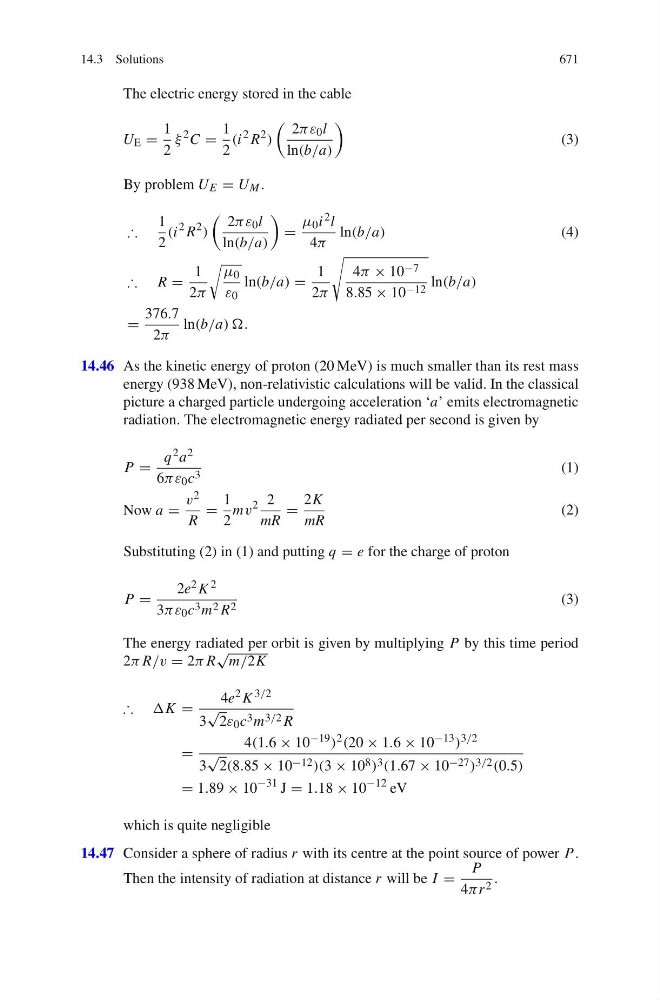
The electric energy stored in the cable
U E =
1
2
ξ
2 C =
1
2
(i
2 R
2
)
2πε 0 l
ln(b/a)
(3)
By problem U E = U M .
∴
1
2
(i
2 R
2
)
2πε 0 l
ln(b/a)
=
μ 0 i 2 l
4π
ln(b/a)
(4)
∴ R =
1
2π
μ 0
ε 0
ln(b/a) =
1
2π
4π × 10 −7
8.85 × 10 −12 ln(b/a)
=
376.7
2π
ln(b/a) ).
14.46 As the kinetic energy of proton (20 MeV) is much smaller than its rest mass
energy (938 MeV), non-relativistic calculations will be valid. In the classical
picture a charged particle undergoing acceleration ‘a’ emits electromagnetic
radiation. The electromagnetic energy radiated per second is given by
P =
q 2 a 2
6πε 0 c 3
(1)
Now a =
v 2
R
=
1
2
mv
2 2
mR
=
2K
mR
(2)
Substituting (2) in (1) and putting q = e for the charge of proton
P =
2e 2 K 2
3πε 0 c 3 m 2 R 2
(3)
The energy radiated per orbit is given by multiplying P by this time period
2π R/v = 2π R
√
m/2K
∴ K =
4e 2 K 3/2
3
√
2ε 0 c 3 m 3/2 R
=
4(1.6 × 10 −19 ) 2 (20 × 1.6 × 10 −13 ) 3/2
3
√
2(8.85 × 10 −12 )(3 × 10 8 ) 3 (1.67 × 10 −27 ) 3/2 (0.5)
= 1.89 × 10
−31 J = 1.18 × 10
−12 eV
which is quite negligible
14.47 Consider a sphere of radius r with its centre at the point source of power P.
Then the intensity of radiation at distance r will be I =
P
4πr 2 .