

668
14 Electromagnetism II
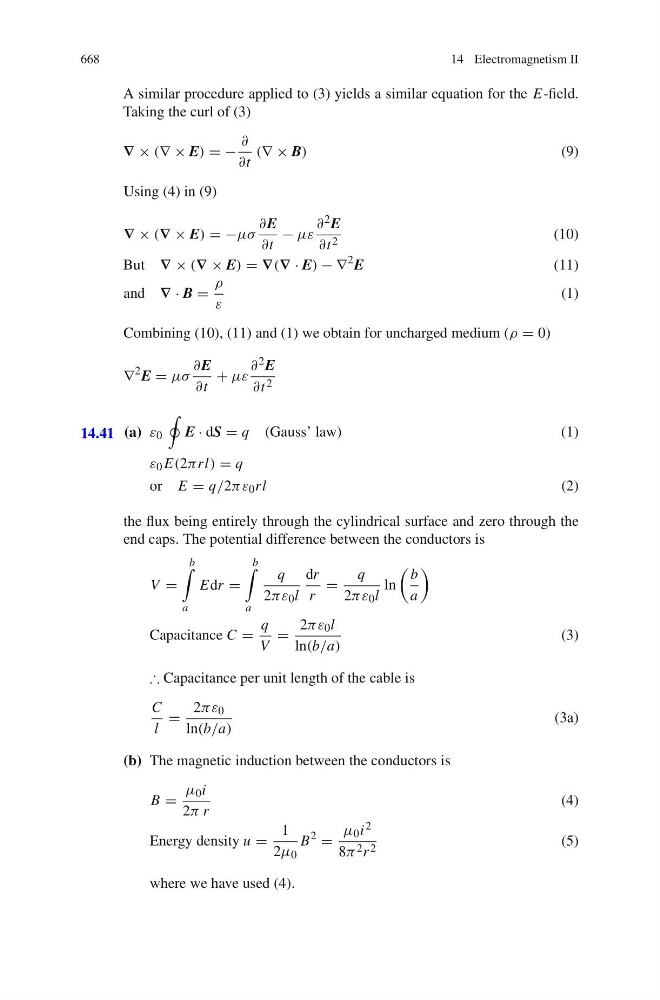
A similar procedure applied to (3) yields a similar equation for the E-field.
Taking the curl of (3)
∇ × (∇ × E) = −
∂
∂t
(∇ × B)
(9)
Using (4) in (9)
∇ × (∇ × E) = −μσ
∂E
∂t
− με
∂ 2 E
∂t 2
(10)
But ∇ × (∇ × E) = ∇(∇ · E) − ∇
2 E
(11)
and ∇ · B =
ρ
ε
(1)
Combining (10), (11) and (1) we obtain for uncharged medium (ρ = 0)
∇
2 E = μσ
∂E
∂t
+ με
∂ 2 E
∂t 2
14.41 (a) ε 0
E · dS = q (Gauss’ law)
(1)
ε 0 E(2πrl) = q
or E = q/2πε 0 rl
(2)
the flux being entirely through the cylindrical surface and zero through the
end caps. The potential difference between the conductors is
V =
b
a
Edr =
b
a
q
2πε 0 l
dr
r
=
q
2πε 0 l
ln
b
a
Capacitance C =
q
V
=
2πε 0 l
ln(b/a)
(3)
∴ Capacitance per unit length of the cable is
C
l
=
2πε 0
ln(b/a)
(3a)
(b) The magnetic induction between the conductors is
B =
μ 0 i
2π r
(4)
Energy density u =
1
2μ 0
B
2
=
μ 0 i 2
8π 2 r 2
(5)
where we have used (4).