

14.3 Solutions
661
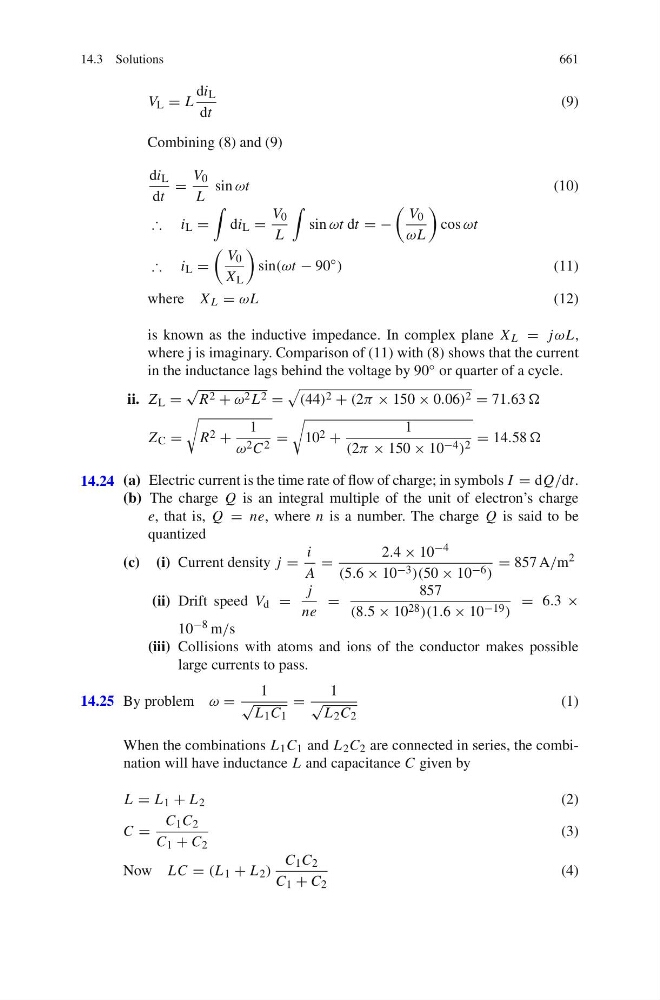
V L = L
di L
dt
(9)
Combining (8) and (9)
di L
dt
=
V 0
L
sin ωt
(10)
∴ i L =
di L =
V 0
L
sin ωt dt = −
V 0
ωL
cos ωt
∴ i L =
V 0
X L
sin(ωt − 90
◦
)
(11)
where X L = ωL
(12)
is known as the inductive impedance. In complex plane X L = jωL,
where j is imaginary. Comparison of (11) with (8) shows that the current
in the inductance lags behind the voltage by 90 ◦ or quarter of a cycle.
ii. Z L =
√
R 2 + ω 2 L 2 =
(44) 2 + (2π × 150 × 0.06) 2 = 71.63
Z C =
R 2 +
1
ω 2 C 2 =
10 2 +
1
(2π × 150 × 10 −4 ) 2 = 14.58
14.24 (a) Electric current is the time rate of flow of charge; in symbols I = dQ/dt.
(b) The charge Q is an integral multiple of the unit of electron’s charge
e, that is, Q = ne, where n is a number. The charge Q is said to be
quantized
(c) (i) Current density j =
i
A
=
2.4 × 10 −4
(5.6 × 10 −3 )(50 × 10 −6 )
= 857 A/m 2
(ii) Drift speed V d =
j
ne
=
857
(8.5 × 10 28 )(1.6 × 10 −19 )
= 6.3 ×
10 −8 m/s
(iii) Collisions with atoms and ions of the conductor makes possible
large currents to pass.
14.25 By problem ω =
1
√
L 1 C 1
=
1
√
L 2 C 2
(1)
When the combinations L 1 C 1 and L 2 C 2 are connected in series, the combination will have inductance L and capacitance C given by
L = L 1 + L 2
(2)
C =
C 1 C 2
C 1 + C 2
(3)
Now LC = (L 1 + L 2 )
C 1 C 2
C 1 + C 2
(4)