

658
14 Electromagnetism II
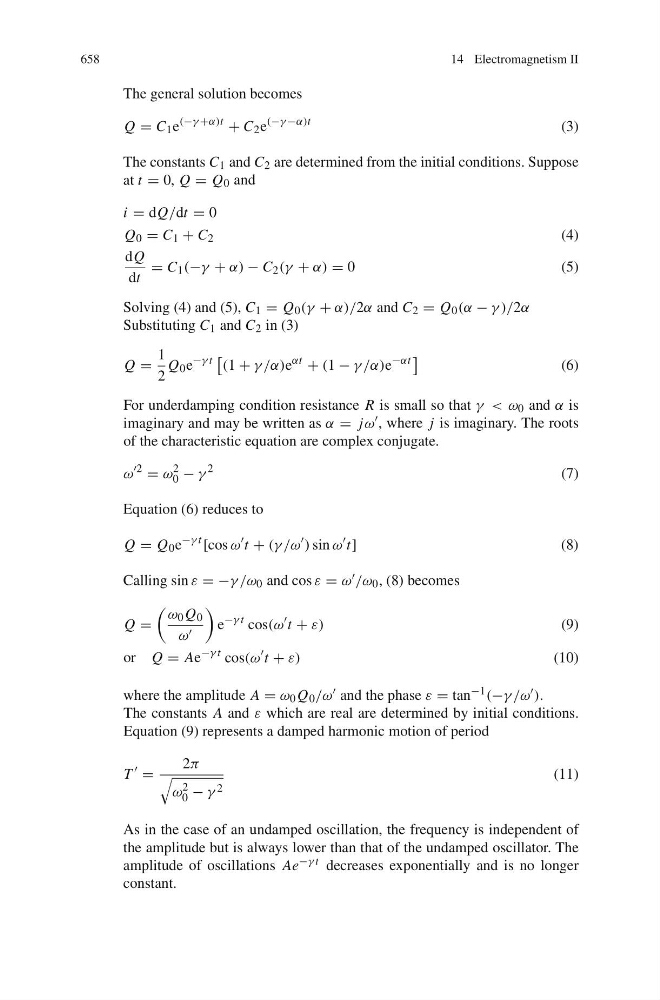
The general solution becomes
Q = C 1 e
(−γ +α)t
+ C 2 e
(−γ −α)t
(3)
The constants C 1 and C 2 are determined from the initial conditions. Suppose
at t = 0, Q = Q 0 and
i = dQ/dt = 0
Q 0 = C 1 + C 2
(4)
dQ
dt
= C 1 (−γ + α) − C 2 (γ + α) = 0
( 5 )
Solving (4) and (5), C 1 = Q 0 (γ + α)/2α and C 2 = Q 0 (α − γ )/2α
Substituting C 1 and C 2 in (3)
Q =
1
2
Q 0 e
−γ t
(1 + γ /α)e
αt
+ (1 − γ /α)e
−αt
(6)
For underdamping condition resistance R is small so that γ < ω 0 and α is
imaginary and may be written as α = jω , where j is imaginary. The roots
of the characteristic equation are complex conjugate.
ω
2
= ω
2
0 − γ
2
(7)
Equation (6) reduces to
Q = Q 0 e
−γ t
[cos ω
t + (γ /ω
) sin ω
t]
(8)
Calling sin ε = −γ /ω 0 and cos ε = ω /ω 0 , (8) becomes
Q =
ω 0 Q 0
ω
e
−γ t cos(ω
t + ε)
(9)
or Q = Ae
−γ t cos(ω
t + ε)
(10)
where the amplitude A = ω 0 Q 0 /ω and the phase ε = tan −1 (−γ /ω ).
The constants A and ε which are real are determined by initial conditions.
Equation (9) represents a damped harmonic motion of period
T
=
2π
ω 2
0 − γ 2
(11)
As in the case of an undamped oscillation, the frequency is independent of
the amplitude but is always lower than that of the undamped oscillator. The
amplitude of oscillations Ae −γ t decreases exponentially and is no longer
constant.