

14.3 Solutions
655
Energy of an inductance, E =
1
2
Li 2
∴ [L] = [Ml
2 T
−2 A
−2
]
(3)
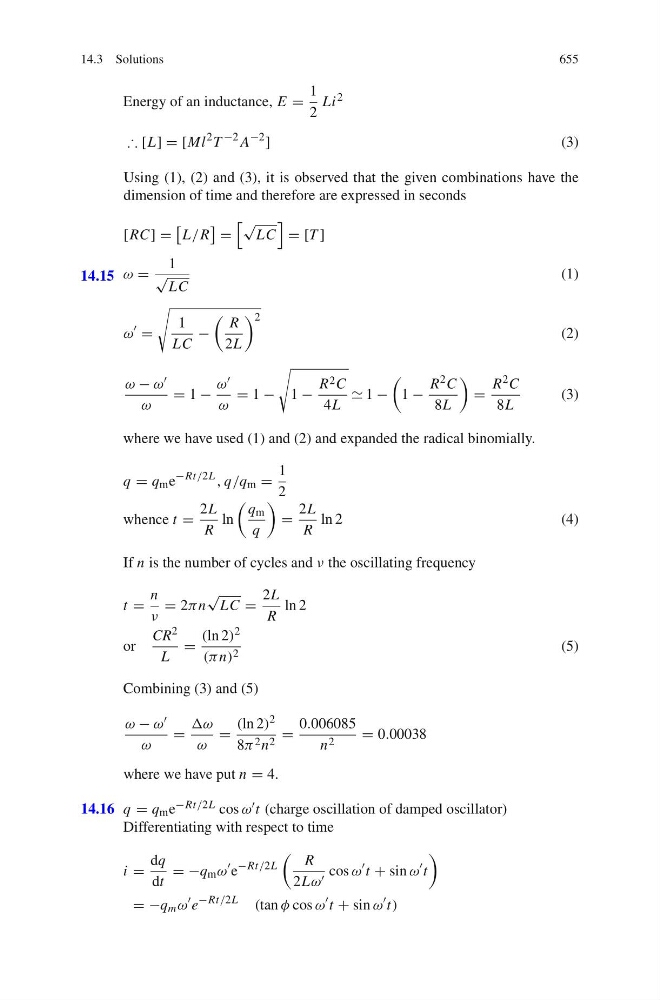
Using (1), (2) and (3), it is observed that the given combinations have the
dimension of time and therefore are expressed in seconds
[RC] =
L/R
=
√
LC
= [T ]
14.15 ω =
1
√
LC
(1)
ω
=
1
LC
−
R
2L
2
(2)
ω − ω
ω
= 1 −
ω
ω
= 1 −
1 −
R 2 C
4L
1 −
1 −
R 2 C
8L
=
R 2 C
8L
(3)
where we have used (1) and (2) and expanded the radical binomially.
q = q m e
−Rt/2L
, q/q m =
1
2
whence t =
2L
R
ln
q m
q
=
2L
R
ln 2
(4)
If n is the number of cycles and ν the oscillating frequency
t =
n
ν
= 2π n
√
LC =
2L
R
ln 2
or
CR
2
L
=
(ln 2) 2
(πn) 2
(5)
Combining (3) and (5)
ω − ω
ω
=
ω
ω
=
(ln 2) 2
8π 2 n 2 =
0.006085
n 2
= 0.00038
where we have put n = 4.
14.16 q = q m e −Rt/2L cos ω t (charge oscillation of damped oscillator)
Differentiating with respect to time
i =
dq
dt
= −q m ω
e
−Rt/2L
R
2Lω cos ω
t + sin ω
t
= −q m ω
e
−Rt/2L
(tan φ cos ω
t + sin ω
t)