

634
14 Electromagnetism II
Parallel Resonance Circuit
f 0 =
1
2π
1
LC
−
R 2
L 2
(14.27)
When R = 0
f 0 =
1
2π
√
LC
(14.28)
Maxwell’s Equations
Differential Form
∇.B = 0 (Gauss’ law of magnetostatics)
(14.29)
∇. D = ρ (Gauss’ law of electrostatics)
(14.30)
∇ × E = −
∂B
∂t
(Faraday’s law)
(14.31)
∇ × H = J +
∂D
∂t
(Ampere–Maxwell law)
(14.32)
Auxillary Equations
D = εE, D = ε 0 E + P
(14.33)
B = μ 0 H, B = μ 0 (H + M)
(14.34)
J = σ E, J = ρv
(14.35)
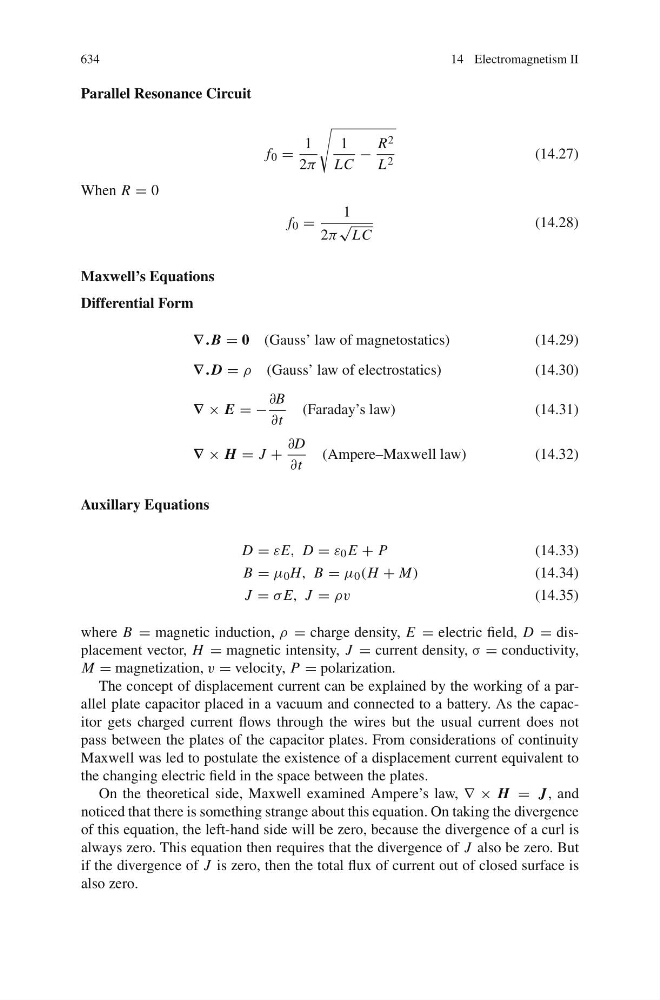
where B = magnetic induction, ρ = charge density, E = electric field, D = displacement vector, H = magnetic intensity, J = current density, σ = conductivity,
M = magnetization, v = velocity, P = polarization.
The concept of displacement current can be explained by the working of a parallel plate capacitor placed in a vacuum and connected to a battery. As the capacitor gets charged current flows through the wires but the usual current does not
pass between the plates of the capacitor plates. From considerations of continuity
Maxwell was led to postulate the existence of a displacement current equivalent to
the changing electric field in the space between the plates.
On the theoretical side, Maxwell examined Ampere’s law, ∇ × H = J, and
noticed that there is something strange about this equation. On taking the divergence
of this equation, the left-hand side will be zero, because the divergence of a curl is
always zero. This equation then requires that the divergence of J also be zero. But
if the divergence of J is zero, then the total flux of current out of closed surface is
also zero.