

2.1 Basic Concepts and Formulae
49
A two-body problem is reduced to a one-body problem through the introduction
of the reduced mass μ.
Motion of a Body of a Variable Mass
It is well known that in relativistic mechanics the mass of a particle increases with
increasing velocity. However, in Newtonian mechanics too one can give meaning
to variable mass as in the following example. Consider an open wagon moving on
rails on a horizontal plane under steady heavy shower. As rain is collected the mass
of the wagon increases at constant rate. Other examples are rocket, motion of jet
propelled vehicles, an engine taking water on the run.
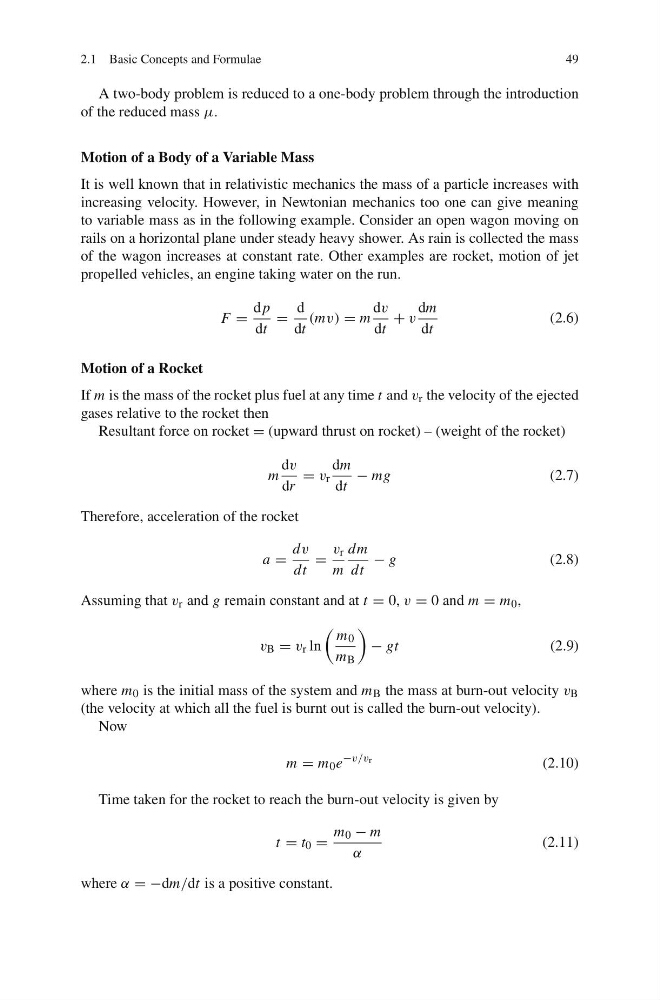
F =
d p
dt
=
d
dt
(mv) = m
dv
dt
+ v
dm
dt
(2.6)
Motion of a Rocket
If m is the mass of the rocket plus fuel at any time t and v r the velocity of the ejected
gases relative to the rocket then
Resultant force on rocket = (upward thrust on rocket) – (weight of the rocket)
m
dv
dr
= v r
dm
dt
− mg
(2.7)
Therefore, acceleration of the rocket
a =
dv
dt
=
v r
m
dm
dt
− g
(2.8)
Assuming that v r and g remain constant and at t = 0, v = 0 and m = m 0 ,
v B = v r ln
m 0
m B
− gt
(2.9)
where m 0 is the initial mass of the system and m B the mass at burn-out velocity v B
(the velocity at which all the fuel is burnt out is called the burn-out velocity).
Now
m = m 0 e
−v/v r
(2.10)
Time taken for the rocket to reach the burn-out velocity is given by
t = t 0 =
m 0 − m
α
(2.11)
where α = −dm/dt is a positive constant.
49
A two-body problem is reduced to a one-body problem through the introduction
of the reduced mass μ.
Motion of a Body of a Variable Mass
It is well known that in relativistic mechanics the mass of a particle increases with
increasing velocity. However, in Newtonian mechanics too one can give meaning
to variable mass as in the following example. Consider an open wagon moving on
rails on a horizontal plane under steady heavy shower. As rain is collected the mass
of the wagon increases at constant rate. Other examples are rocket, motion of jet
propelled vehicles, an engine taking water on the run.
F =
d p
dt
=
d
dt
(mv) = m
dv
dt
+ v
dm
dt
(2.6)
Motion of a Rocket
If m is the mass of the rocket plus fuel at any time t and v r the velocity of the ejected
gases relative to the rocket then
Resultant force on rocket = (upward thrust on rocket) – (weight of the rocket)
m
dv
dr
= v r
dm
dt
− mg
(2.7)
Therefore, acceleration of the rocket
a =
dv
dt
=
v r
m
dm
dt
− g
(2.8)
Assuming that v r and g remain constant and at t = 0, v = 0 and m = m 0 ,
v B = v r ln
m 0
m B
− gt
(2.9)
where m 0 is the initial mass of the system and m B the mass at burn-out velocity v B
(the velocity at which all the fuel is burnt out is called the burn-out velocity).
Now
m = m 0 e
−v/v r
(2.10)
Time taken for the rocket to reach the burn-out velocity is given by
t = t 0 =
m 0 − m
α
(2.11)
where α = −dm/dt is a positive constant.