

618
13 Electromagnetism I
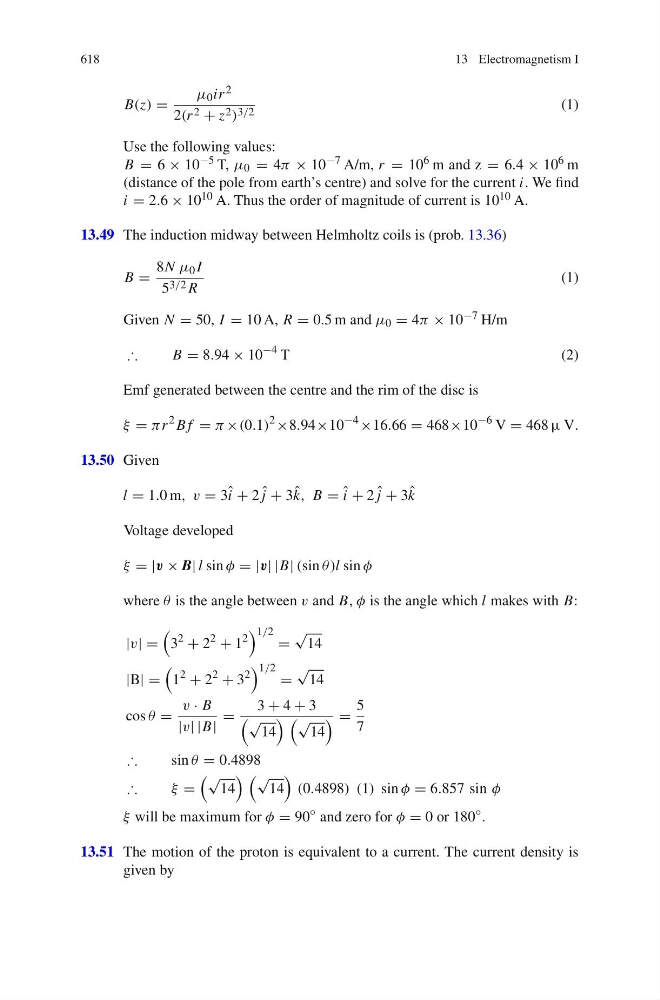
B(z) =
μ 0 ir 2
2(r 2 + z 2 ) 3/2
(1)
Use the following values:
B = 6 × 10 −5 T, μ 0 = 4π × 10 −7 A/m, r = 10 6 m and z = 6.4 × 10 6 m
(distance of the pole from earth’s centre) and solve for the current i. We find
i = 2.6 × 10 10 A. Thus the order of magnitude of current is 10 10 A.
13.49 The induction midway between Helmholtz coils is (prob. 13.36)
B =
8N μ 0 I
5 3/2 R
(1)
Given N = 50, I = 10 A, R = 0.5 m and μ 0 = 4π × 10 −7 H/m
∴
B = 8.94 × 10
−4 T
( 2 )
Emf generated between the centre and the rim of the disc is
ξ = πr
2 B f = π ×(0.1)
2
×8.94×10
−4
×16.66 = 468×10
−6 V = 468 μ V.
13.50 Given
l = 1.0 m, v = 3 ˆ
i + 2 ˆ
j + 3 ˆ
k, B = ˆ
i + 2 ˆ
j + 3 ˆ
k
Voltage developed
ξ = |v × B| l sin φ = |v| |B| (sin θ)l sin φ
where θ is the angle between v and B, φ is the angle which l makes with B:
|v| =
3
2
+ 2
2
+ 1
2
1/2 =
√
14
|B| =
1
2
+ 2
2
+ 3
2
1/2 =
√
14
cos θ =
v · B
|v| |B|
=
3 + 4 + 3
√
14
√
14
=
5
7
∴
sin θ = 0.4898
∴
ξ =
√
14
√
14
(0.4898) (1) sin φ = 6.857 sin φ
ξ will be maximum for φ = 90
◦ and zero for φ = 0 or 180
◦
.
13.51 The motion of the proton is equivalent to a current. The current density is
given by