

614
13 Electromagnetism I
Differentiate B with respect to x and evaluate
∂ B
∂ x
x = 0
to find the first
derivative zero. Differentiate B once again to find
∂ 2 B
∂ x 2
x = 0
= 0. Thus
the field around P is seen to be fairly uniform.
13.39 (i) B =
μ 0 i
2π r
(r > R)
(1)
=
4π × 10 −7 × 100
2π × 1.0
= 2 × 10
−5 T
(ii) B =
μ 0 ir
2π R 2
(r < R)
(2)
=
4π × 10 −7 × 100 × 6 × 10 −3
2π × (3 × 10 −2 ) 2
= 1.33 × 10
−6 T
13.40 (a) B t l = μ 0 i
(Ampere’s law)
Bl = B l = B · 2π r = μ 0 i
where we enclose the current i by going round once the circle of radius
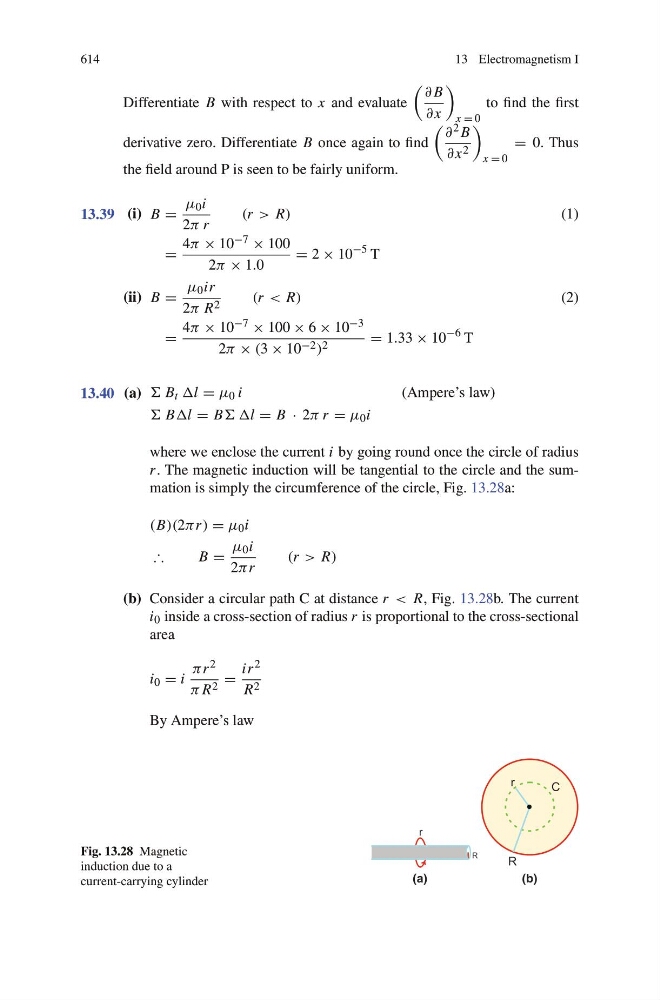
r . The magnetic induction will be tangential to the circle and the summation is simply the circumference of the circle, Fig. 13.28a:
(B)(2πr ) = μ 0 i
∴
B =
μ 0 i
2πr
(r > R)
(b) Consider a circular path C at distance r < R, Fig. 13.28b. The current
i 0 inside a cross-section of radius r is proportional to the cross-sectional
area
i 0 = i
πr 2
π R 2 =
ir 2
R 2
By Ampere’s law
Fig. 13.28 Magnetic
induction due to a
current-carrying cylinder
(a)
(b)