

596
13 Electromagnetism I
13.2.5 Faraday’s Law
13.67 A flexible circular wire expands such that its radius increases linearly with
time. It is located in a magnetic field perpendicular to the loop. Show that the
emf induced in the wire varies linearly with time.
13.68 An aeroplane, with a wing span of 30 m, is flying horizontally at a speed of
720 km/h, at a point where the vertical component of the earth’s field is 0.4
Oe. What is the emf developed between its wing tips.
[University of Durham]
13.69 A metal disc of radius 0.1 m spins about a horizontal axis lying in the magnetic meridian at a speed of 5 rev/s. If the horizontal component of the earth’s
field is B = 2 × 10 −5 Wb/m
2 , calculate the potential difference between the
centre and the outer edge of the disc.
[University of Durham]
13.70 A coil is 30 turns of wire, each of area 10 cm 2 , is placed with its plane at right
angles to a magnetic field of 0.1 T. When the coil is suddenly withdrawn
from the field, a galvanometer in series with the coil indicates that 10 −5 C
passes around the circuit. What is the combined resistance of the coil and the
galvanometer?
[University of Cambridge]
13.71 A wire loop of area 0.2 m 2 has a resistance of 20 . A magnetic field, normal
to the loop, initially has a magnitude of 0.25 T and is reduced to zero at a
uniform rate in 10 −4 s. Estimate the induced emf and the resulting current.
13.72 A square wire with a loop of resistance 4 , with sides 25 cm rotates 40 times
per second about a horizontal axis. The magnetic field is vertical and has a
magnitude of 0.5 T. Estimate the amplitude of the induced current.
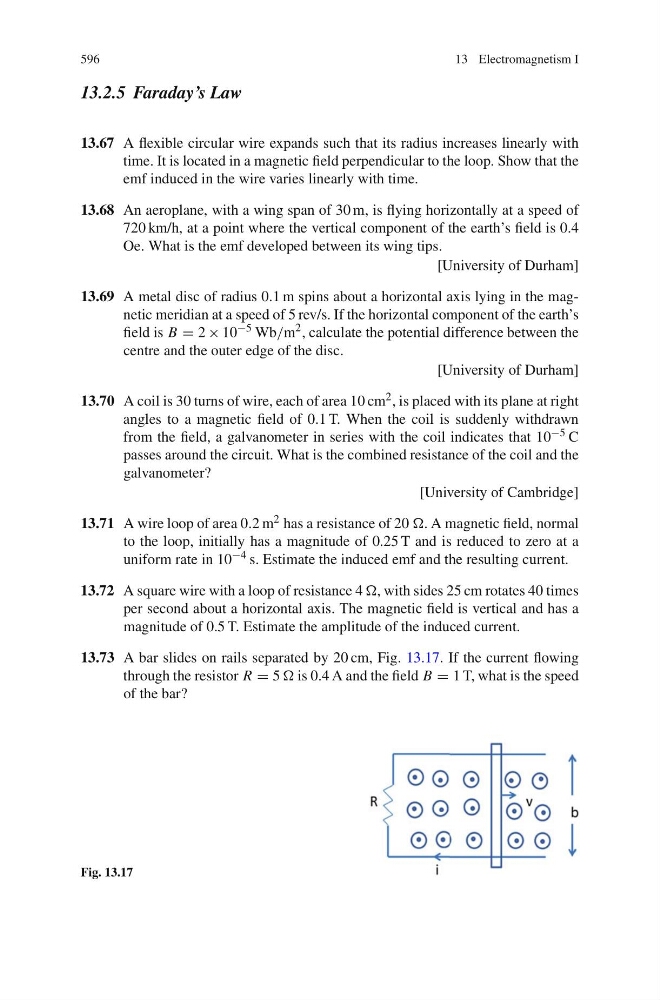
13.73 A bar slides on rails separated by 20 cm, Fig. 13.17. If the current flowing
through the resistor R = 5 is 0.4 A and the field B = 1 T, what is the speed
of the bar?
Fig. 13.17