

590
13 Electromagnetism I
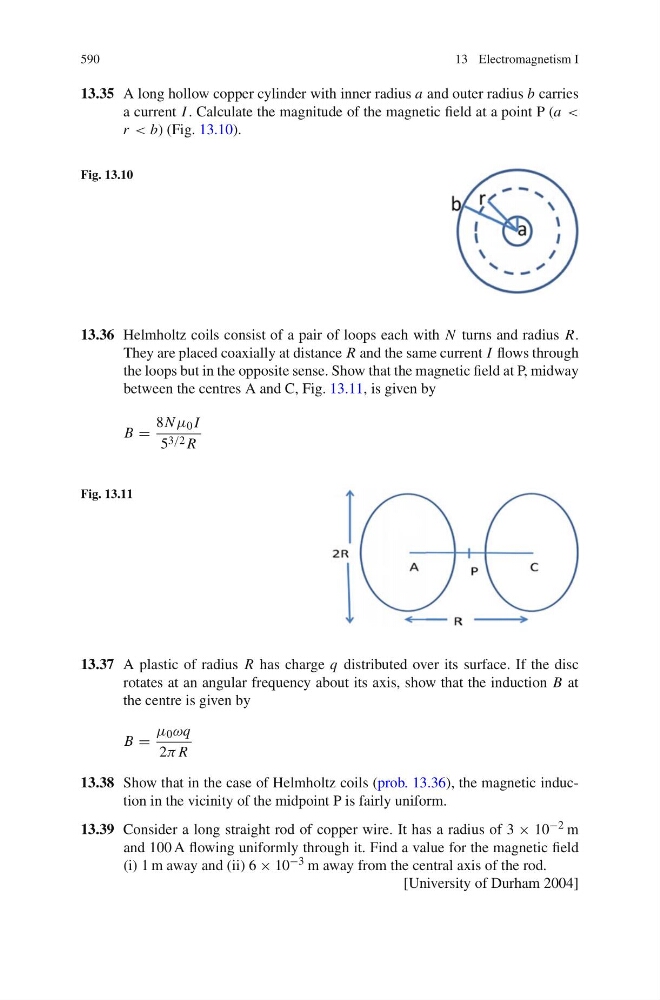
13.35 A long hollow copper cylinder with inner radius a and outer radius b carries
a current I . Calculate the magnitude of the magnetic field at a point P (a <
r < b) (Fig. 13.10).
Fig. 13.10
13.36 Helmholtz coils consist of a pair of loops each with N turns and radius R.
They are placed coaxially at distance R and the same current I flows through
the loops but in the opposite sense. Show that the magnetic field at P, midway
between the centres A and C, Fig. 13.11, is given by
B =
8N μ 0 I
5 3/2 R
Fig. 13.11
13.37 A plastic of radius R has charge q distributed over its surface. If the disc
rotates at an angular frequency about its axis, show that the induction B at
the centre is given by
B =
μ 0 ωq
2π R
13.38 Show that in the case of Helmholtz coils (prob. 13.36), the magnetic induction in the vicinity of the midpoint P is fairly uniform.
13.39 Consider a long straight rod of copper wire. It has a radius of 3 × 10 −2 m
and 100 A flowing uniformly through it. Find a value for the magnetic field
(i) 1 m away and (ii) 6 × 10 −3 m away from the central axis of the rod.
[University of Durham 2004]