

13.2 Problems
585
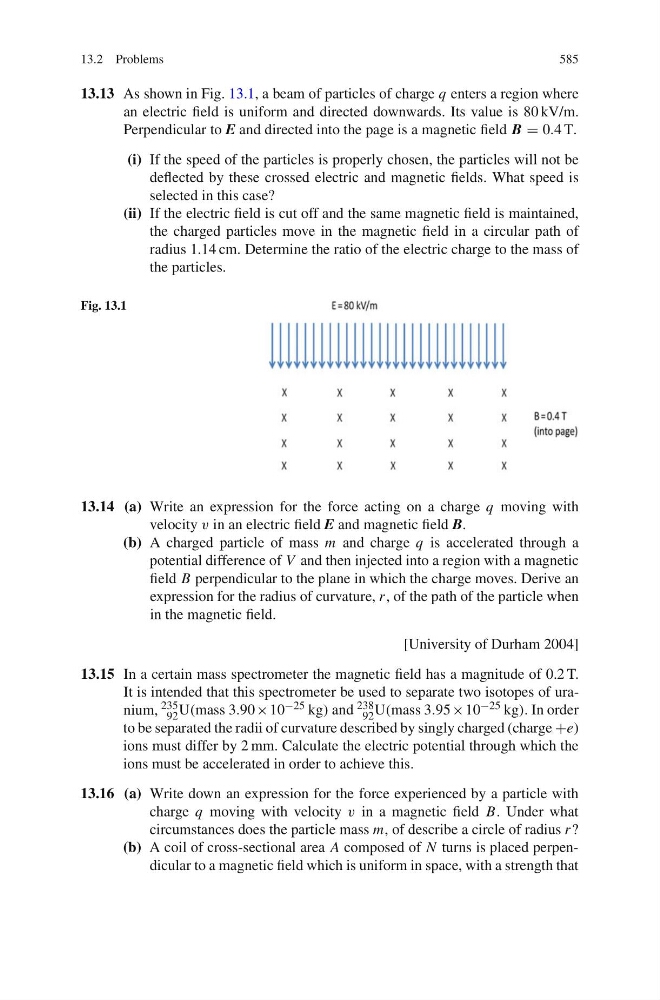
13.13 As shown in Fig. 13.1, a beam of particles of charge q enters a region where
an electric field is uniform and directed downwards. Its value is 80 kV/m.
Perpendicular to E and directed into the page is a magnetic field B = 0.4 T.
(i) If the speed of the particles is properly chosen, the particles will not be
deflected by these crossed electric and magnetic fields. What speed is
selected in this case?
(ii) If the electric field is cut off and the same magnetic field is maintained,
the charged particles move in the magnetic field in a circular path of
radius 1.14 cm. Determine the ratio of the electric charge to the mass of
the particles.
Fig. 13.1
13.14 (a) Write an expression for the force acting on a charge q moving with
velocity v in an electric field E and magnetic field B.
(b) A charged particle of mass m and charge q is accelerated through a
potential difference of V and then injected into a region with a magnetic
field B perpendicular to the plane in which the charge moves. Derive an
expression for the radius of curvature, r , of the path of the particle when
in the magnetic field.
[University of Durham 2004]
13.15 In a certain mass spectrometer the magnetic field has a magnitude of 0.2 T.
It is intended that this spectrometer be used to separate two isotopes of uranium, 235
92 U(mass 3.90 × 10 −25 kg) and 238
92 U(mass 3.95 × 10 −25 kg). In order
to be separated the radii of curvature described by singly charged (charge +e)
ions must differ by 2 mm. Calculate the electric potential through which the
ions must be accelerated in order to achieve this.
13.16 (a) Write down an expression for the force experienced by a particle with
charge q moving with velocity v in a magnetic field B. Under what
circumstances does the particle mass m, of describe a circle of radius r ?
(b) A coil of cross-sectional area A composed of N turns is placed perpendicular to a magnetic field which is uniform in space, with a strength that