

44
1 Kinematics and Statics
1.3.6 Equilibrium
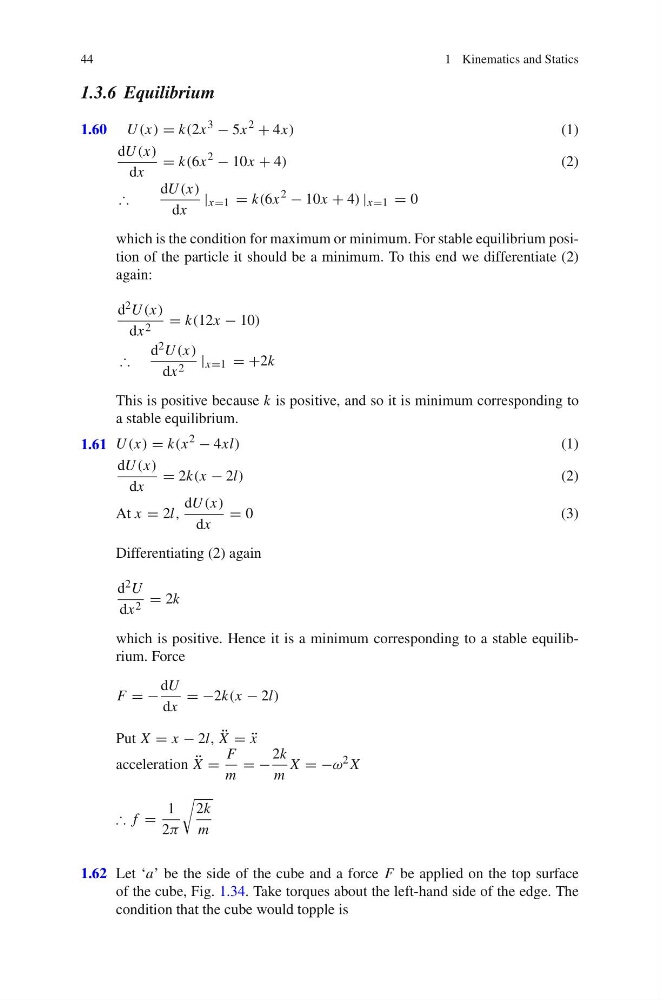
1.60 U (x) = k(2x
3
− 5x
2
+ 4x)
(1)
dU (x)
dx
= k(6x
2
− 10x + 4)
(2)
∴
dU (x)
dx
| x=1 = k(6x
2
− 10x + 4) | x=1 = 0
which is the condition for maximum or minimum. For stable equilibrium position of the particle it should be a minimum. To this end we differentiate (2)
again:
d 2 U (x)
dx 2 = k(12x − 10)
∴
d 2 U (x)
dx 2 | x=1 = +2k
This is positive because k is positive, and so it is minimum corresponding to
a stable equilibrium.
1.61 U (x) = k(x
2
− 4xl)
(1)
dU (x)
dx
= 2k(x − 2l)
(2)
At x = 2l,
dU (x)
dx
= 0
( 3 )
Differentiating (2) again
d 2 U
dx 2 = 2k
which is positive. Hence it is a minimum corresponding to a stable equilibrium. Force
F = −
dU
dx
= −2k(x − 2l)
Put X = x − 2l, ¨
X = ¨
x
acceleration ¨
X =
F
m
= −
2k
m
X = −ω 2 X
∴ f =
1
2π
2k
m
1.62 Let ‘a’ be the side of the cube and a force F be applied on the top surface
of the cube, Fig. 1.34. Take torques about the left-hand side of the edge. The
condition that the cube would topple is
1 Kinematics and Statics
1.3.6 Equilibrium
1.60 U (x) = k(2x
3
− 5x
2
+ 4x)
(1)
dU (x)
dx
= k(6x
2
− 10x + 4)
(2)
∴
dU (x)
dx
| x=1 = k(6x
2
− 10x + 4) | x=1 = 0
which is the condition for maximum or minimum. For stable equilibrium position of the particle it should be a minimum. To this end we differentiate (2)
again:
d 2 U (x)
dx 2 = k(12x − 10)
∴
d 2 U (x)
dx 2 | x=1 = +2k
This is positive because k is positive, and so it is minimum corresponding to
a stable equilibrium.
1.61 U (x) = k(x
2
− 4xl)
(1)
dU (x)
dx
= 2k(x − 2l)
(2)
At x = 2l,
dU (x)
dx
= 0
( 3 )
Differentiating (2) again
d 2 U
dx 2 = 2k
which is positive. Hence it is a minimum corresponding to a stable equilibrium. Force
F = −
dU
dx
= −2k(x − 2l)
Put X = x − 2l, ¨
X = ¨
x
acceleration ¨
X =
F
m
= −
2k
m
X = −ω 2 X
∴ f =
1
2π
2k
m
1.62 Let ‘a’ be the side of the cube and a force F be applied on the top surface
of the cube, Fig. 1.34. Take torques about the left-hand side of the edge. The
condition that the cube would topple is