

582
13 Electromagnetism I
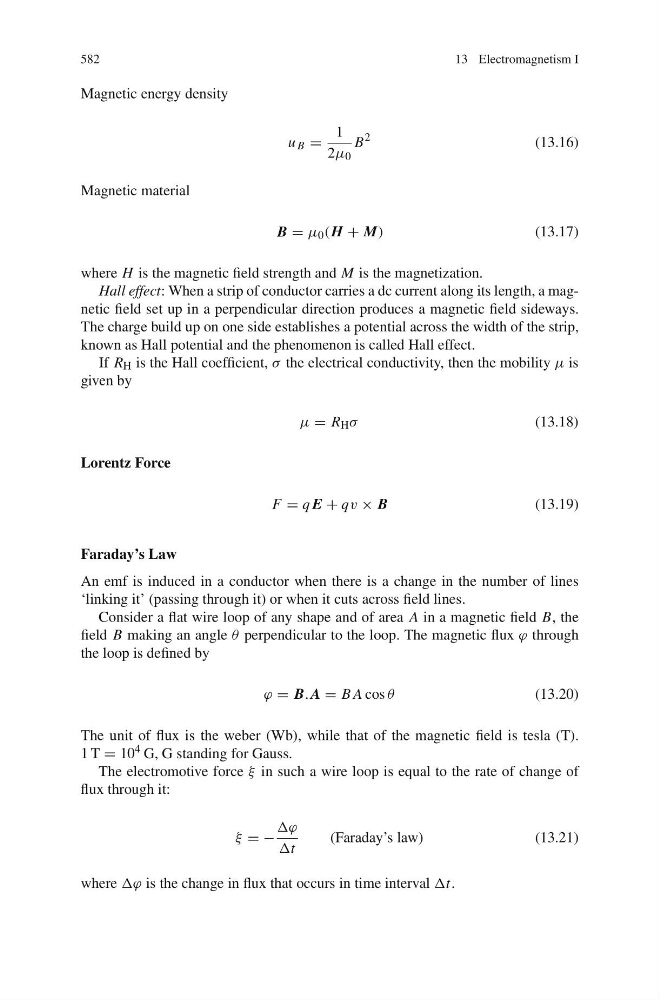
Magnetic energy density
u B =
1
2μ 0
B
2
(13.16)
Magnetic material
B = μ 0 (H + M)
(13.17)
where H is the magnetic field strength and M is the magnetization.
Hall effect: When a strip of conductor carries a dc current along its length, a magnetic field set up in a perpendicular direction produces a magnetic field sideways.
The charge build up on one side establishes a potential across the width of the strip,
known as Hall potential and the phenomenon is called Hall effect.
If R H is the Hall coefficient, σ the electrical conductivity, then the mobility μ is
given by
μ = R H σ
(13.18)
Lorentz Force
F = q E + qv × B
(13.19)
Faraday’s Law
An emf is induced in a conductor when there is a change in the number of lines
‘linking it’ (passing through it) or when it cuts across field lines.
Consider a flat wire loop of any shape and of area A in a magnetic field B, the
field B making an angle θ perpendicular to the loop. The magnetic flux ϕ through
the loop is defined by
ϕ = B. A = B A cos θ
(13.20)
The unit of flux is the weber (Wb), while that of the magnetic field is tesla (T).
1 T = 10 4 G, G standing for Gauss.
The electromotive force ξ in such a wire loop is equal to the rate of change of
flux through it:
ξ = −
ϕ
t
(Faraday’s law)
(13.21)
where ϕ is the change in flux that occurs in time interval t.