

578
12 Electric Circuits
12.55 i 1 − i 2 − i 3 = 0
(junction theorem)
(1)
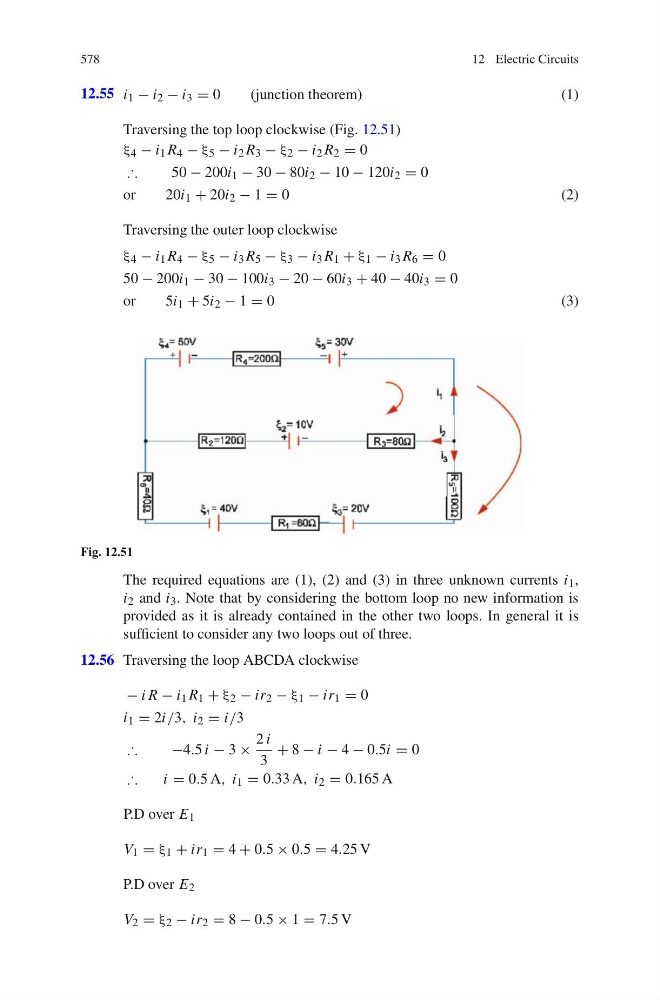
Traversing the top loop clockwise (Fig. 12.51)
ξ 4 − i 1 R 4 − ξ 5 − i 2 R 3 − ξ 2 − i 2 R 2 = 0
∴
50 − 200i 1 − 30 − 80i 2 − 10 − 120i 2 = 0
or
20i 1 + 20i 2 − 1 = 0
( 2 )
Traversing the outer loop clockwise
ξ 4 − i 1 R 4 − ξ 5 − i 3 R 5 − ξ 3 − i 3 R 1 + ξ 1 − i 3 R 6 = 0
50 − 200i 1 − 30 − 100i 3 − 20 − 60i 3 + 40 − 40i 3 = 0
or
5i 1 + 5i 2 − 1 = 0
( 3 )
Fig. 12.51
The required equations are (1), (2) and (3) in three unknown currents i 1 ,
i 2 and i 3 . Note that by considering the bottom loop no new information is
provided as it is already contained in the other two loops. In general it is
sufficient to consider any two loops out of three.
12.56 Traversing the loop ABCDA clockwise
− i R − i 1 R 1 + ξ 2 − ir 2 − ξ 1 − ir 1 = 0
i 1 = 2i/3, i 2 = i/3
∴
−4.5 i − 3 ×
2 i
3
+ 8 − i − 4 − 0.5i = 0
∴
i = 0.5 A, i 1 = 0.33 A, i 2 = 0.165 A
P.D over E 1
V 1 = ξ 1 + ir 1 = 4 + 0.5 × 0.5 = 4.25 V
P.D over E 2
V 2 = ξ 2 − ir 2 = 8 − 0.5 × 1 = 7.5 V