

12.3 Solutions
575
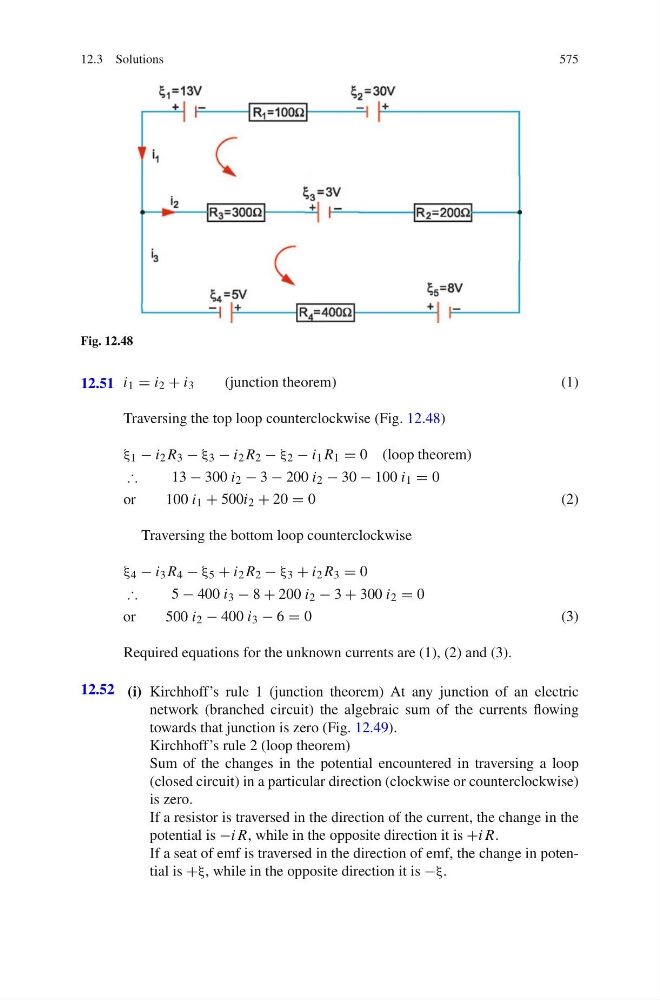
Fig. 12.48
12.51 i 1 = i 2 + i 3
(junction theorem)
(1)
Traversing the top loop counterclockwise (Fig. 12.48)
ξ 1 − i 2 R 3 − ξ 3 − i 2 R 2 − ξ 2 − i 1 R 1 = 0 (loop theorem)
∴
13 − 300 i 2 − 3 − 200 i 2 − 30 − 100 i 1 = 0
or
100 i 1 + 500i 2 + 20 = 0
( 2 )
Traversing the bottom loop counterclockwise
ξ 4 − i 3 R 4 − ξ 5 + i 2 R 2 − ξ 3 + i 2 R 3 = 0
∴
5 − 400 i 3 − 8 + 200 i 2 − 3 + 300 i 2 = 0
or
500 i 2 − 400 i 3 − 6 = 0
( 3 )
Required equations for the unknown currents are (1), (2) and (3).
12.52 (i) Kirchhoff’s rule 1 (junction theorem) At any junction of an electric
network (branched circuit) the algebraic sum of the currents flowing
towards that junction is zero (Fig. 12.49).
Kirchhoff’s rule 2 (loop theorem)
Sum of the changes in the potential encountered in traversing a loop
(closed circuit) in a particular direction (clockwise or counterclockwise)
is zero.
If a resistor is traversed in the direction of the current, the change in the
potential is −i R, while in the opposite direction it is +i R.
If a seat of emf is traversed in the direction of emf, the change in potential is +ξ, while in the opposite direction it is −ξ.