

572
12 Electric Circuits
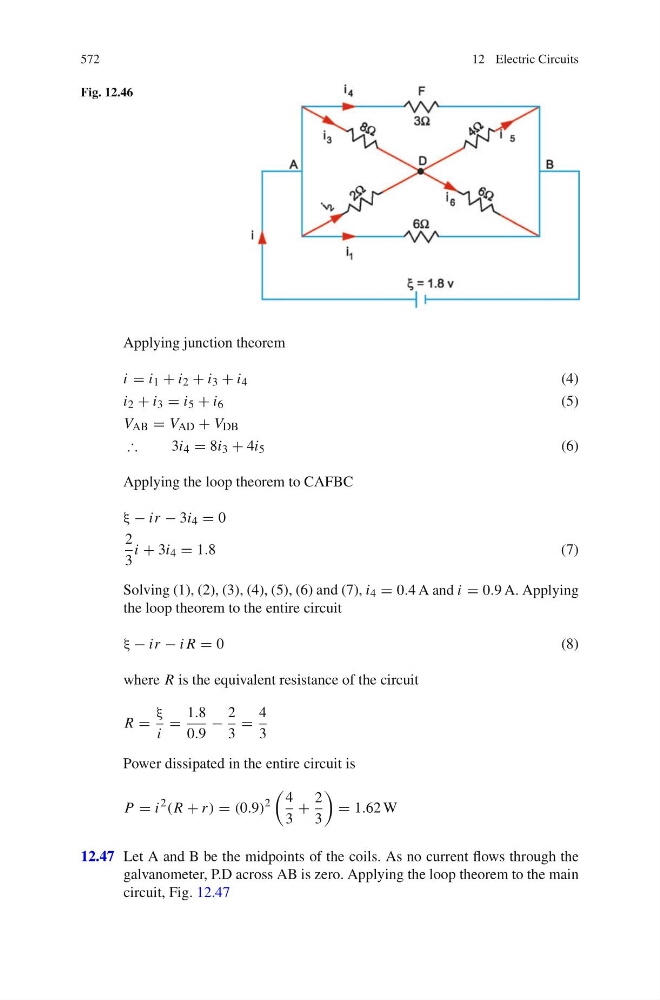
Fig. 12.46
Applying junction theorem
i = i 1 + i 2 + i 3 + i 4
(4)
i 2 + i 3 = i 5 + i 6
(5)
V AB = V AD + V DB
∴
3i 4 = 8i 3 + 4i 5
(6)
Applying the loop theorem to CAFBC
ξ − ir − 3i 4 = 0
2
3
i + 3i 4 = 1.8
( 7 )
Solving (1), (2), (3), (4), (5), (6) and (7), i 4 = 0.4 A and i = 0.9 A. Applying
the loop theorem to the entire circuit
ξ − ir − i R = 0
( 8 )
where R is the equivalent resistance of the circuit
R =
ξ
i
=
1.8
0.9
−
2
3
=
4
3
Power dissipated in the entire circuit is
P = i
2
(R + r ) = (0.9)
2
4
3
+
2
3
= 1.62 W
12.47 Let A and B be the midpoints of the coils. As no current flows through the
galvanometer, P.D across AB is zero. Applying the loop theorem to the main
circuit, Fig. 12.47