

548
12 Electric Circuits
12.45 The electric current of 5 A is divided into three branches, forming a parallel
combination. The lengths of the wire in the three branches are in the ratio 2,
3 and 4; their diameters are in the ratio 3, 4 and 5. Find the current in each
branch, if the wires are of the same material.
[Indian Institute of Technology 1975]
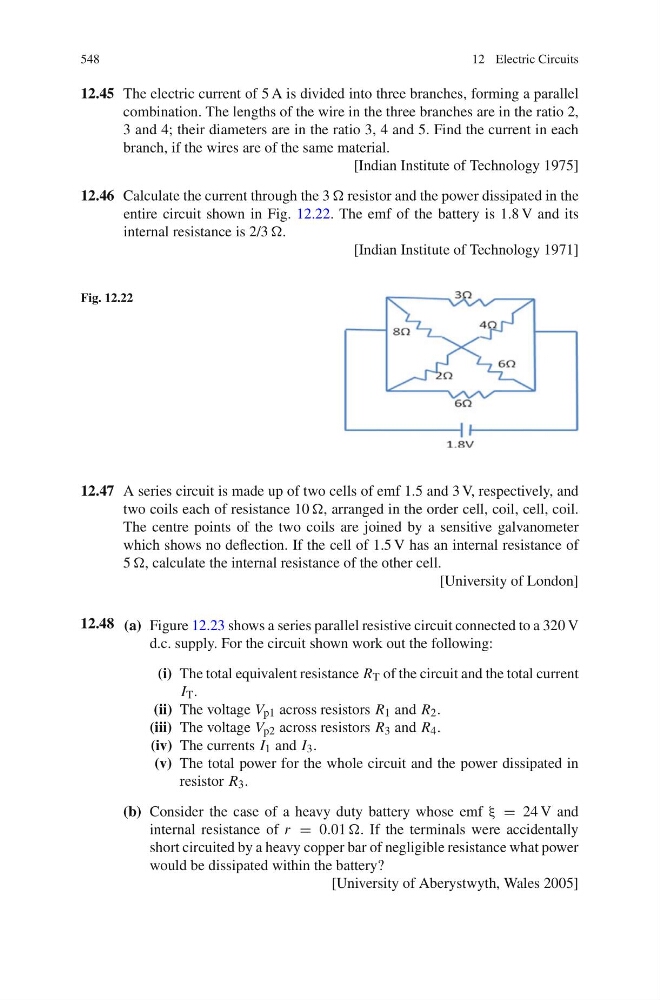
12.46 Calculate the current through the 3 resistor and the power dissipated in the
entire circuit shown in Fig. 12.22. The emf of the battery is 1.8 V and its
internal resistance is 2/3 .
[Indian Institute of Technology 1971]
Fig. 12.22
12.47 A series circuit is made up of two cells of emf 1.5 and 3 V, respectively, and
two coils each of resistance 10 , arranged in the order cell, coil, cell, coil.
The centre points of the two coils are joined by a sensitive galvanometer
which shows no deflection. If the cell of 1.5 V has an internal resistance of
5 , calculate the internal resistance of the other cell.
[University of London]
12.48 (a) Figure 12.23 shows a series parallel resistive circuit connected to a 320 V
d.c. supply. For the circuit shown work out the following:
(i) The total equivalent resistance R T of the circuit and the total current
I T .
(ii) The voltage V p1 across resistors R 1 and R 2 .
(iii) The voltage V p2 across resistors R 3 and R 4 .
(iv) The currents I 1 and I 3 .
(v) The total power for the whole circuit and the power dissipated in
resistor R 3 .
(b) Consider the case of a heavy duty battery whose emf ξ = 24 V and
internal resistance of r = 0.01 . If the terminals were accidentally
short circuited by a heavy copper bar of negligible resistance what power
would be dissipated within the battery?
[University of Aberystwyth, Wales 2005]