

542
12 Electric Circuits
and leaves the diagonally opposite corner. Calculate the equivalent resistance
of the network and the fall of potential across it (Fig. 12.11).
[University of London]
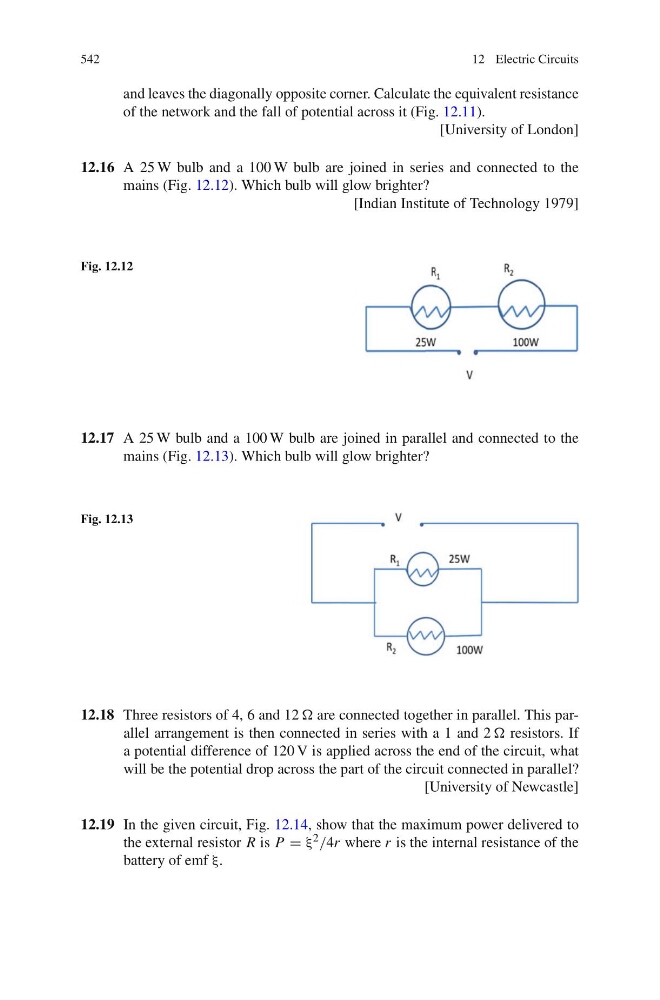
12.16 A 25 W bulb and a 100 W bulb are joined in series and connected to the
mains (Fig. 12.12). Which bulb will glow brighter?
[Indian Institute of Technology 1979]
Fig. 12.12
12.17 A 25 W bulb and a 100 W bulb are joined in parallel and connected to the
mains (Fig. 12.13). Which bulb will glow brighter?
Fig. 12.13
12.18 Three resistors of 4, 6 and 12 are connected together in parallel. This parallel arrangement is then connected in series with a 1 and 2 resistors. If
a potential difference of 120 V is applied across the end of the circuit, what
will be the potential drop across the part of the circuit connected in parallel?
[University of Newcastle]
12.19 In the given circuit, Fig. 12.14, show that the maximum power delivered to
the external resistor R is P = ξ 2 /4r where r is the internal resistance of the
battery of emf ξ.