

520
11 Electrostatics
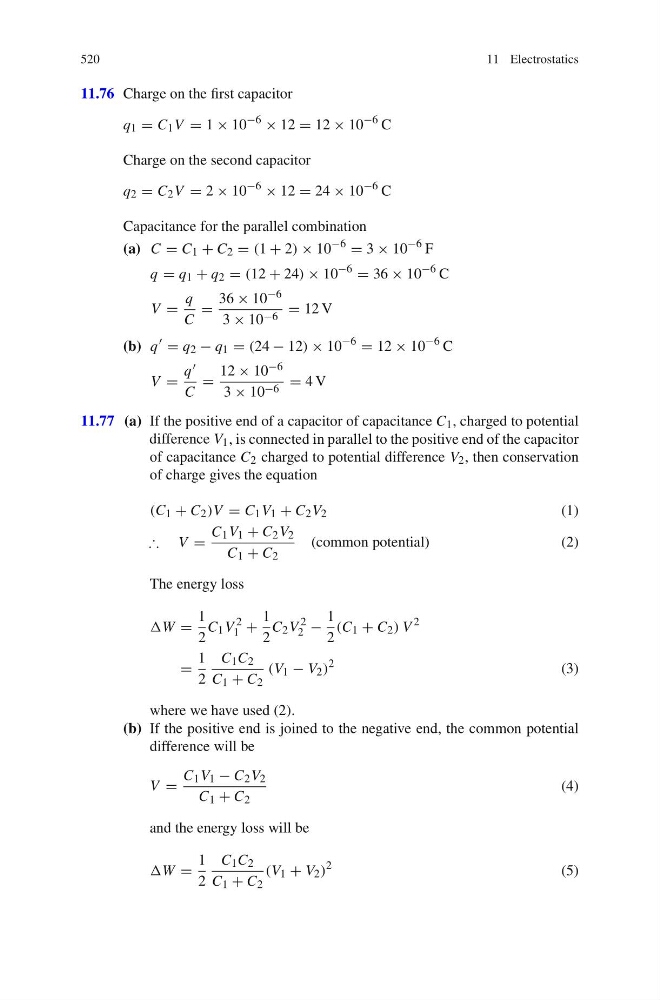
11.76 Charge on the first capacitor
q 1 = C 1 V = 1 × 10
−6
× 12 = 12 × 10
−6 C
Charge on the second capacitor
q 2 = C 2 V = 2 × 10
−6
× 12 = 24 × 10
−6 C
Capacitance for the parallel combination
(a) C = C 1 + C 2 = (1 + 2) × 10
−6
= 3 × 10
−6 F
q = q 1 + q 2 = (12 + 24) × 10
−6
= 36 × 10
−6 C
V =
q
C
=
36 × 10 −6
3 × 10 −6 = 12 V
(b) q
= q 2 − q 1 = (24 − 12) × 10
−6
= 12 × 10
−6 C
V =
q
C
=
12 × 10 −6
3 × 10 −6 = 4 V
11.77 (a) If the positive end of a capacitor of capacitance C 1 , charged to potential
difference V 1 , is connected in parallel to the positive end of the capacitor
of capacitance C 2 charged to potential difference V 2 , then conservation
of charge gives the equation
(C 1 + C 2 )V = C 1 V 1 + C 2 V 2
(1)
∴ V =
C 1 V 1 + C 2 V 2
C 1 + C 2
(common potential)
(2)
The energy loss
W =
1
2
C 1 V
2
1 +
1
2
C 2 V
2
2 −
1
2
(C 1 + C 2 ) V
2
=
1
2
C 1 C 2
C 1 + C 2
(V 1 − V 2 )
2
(3)
where we have used (2).
(b) If the positive end is joined to the negative end, the common potential
difference will be
V =
C 1 V 1 − C 2 V 2
C 1 + C 2
(4)
and the energy loss will be
W =
1
2
C 1 C 2
C 1 + C 2
(V 1 + V 2 )
2
(5)
11 Electrostatics
11.76 Charge on the first capacitor
q 1 = C 1 V = 1 × 10
−6
× 12 = 12 × 10
−6 C
Charge on the second capacitor
q 2 = C 2 V = 2 × 10
−6
× 12 = 24 × 10
−6 C
Capacitance for the parallel combination
(a) C = C 1 + C 2 = (1 + 2) × 10
−6
= 3 × 10
−6 F
q = q 1 + q 2 = (12 + 24) × 10
−6
= 36 × 10
−6 C
V =
q
C
=
36 × 10 −6
3 × 10 −6 = 12 V
(b) q
= q 2 − q 1 = (24 − 12) × 10
−6
= 12 × 10
−6 C
V =
q
C
=
12 × 10 −6
3 × 10 −6 = 4 V
11.77 (a) If the positive end of a capacitor of capacitance C 1 , charged to potential
difference V 1 , is connected in parallel to the positive end of the capacitor
of capacitance C 2 charged to potential difference V 2 , then conservation
of charge gives the equation
(C 1 + C 2 )V = C 1 V 1 + C 2 V 2
(1)
∴ V =
C 1 V 1 + C 2 V 2
C 1 + C 2
(common potential)
(2)
The energy loss
W =
1
2
C 1 V
2
1 +
1
2
C 2 V
2
2 −
1
2
(C 1 + C 2 ) V
2
=
1
2
C 1 C 2
C 1 + C 2
(V 1 − V 2 )
2
(3)
where we have used (2).
(b) If the positive end is joined to the negative end, the common potential
difference will be
V =
C 1 V 1 − C 2 V 2
C 1 + C 2
(4)
and the energy loss will be
W =
1
2
C 1 C 2
C 1 + C 2
(V 1 + V 2 )
2
(5)