

11.3 Solutions
511
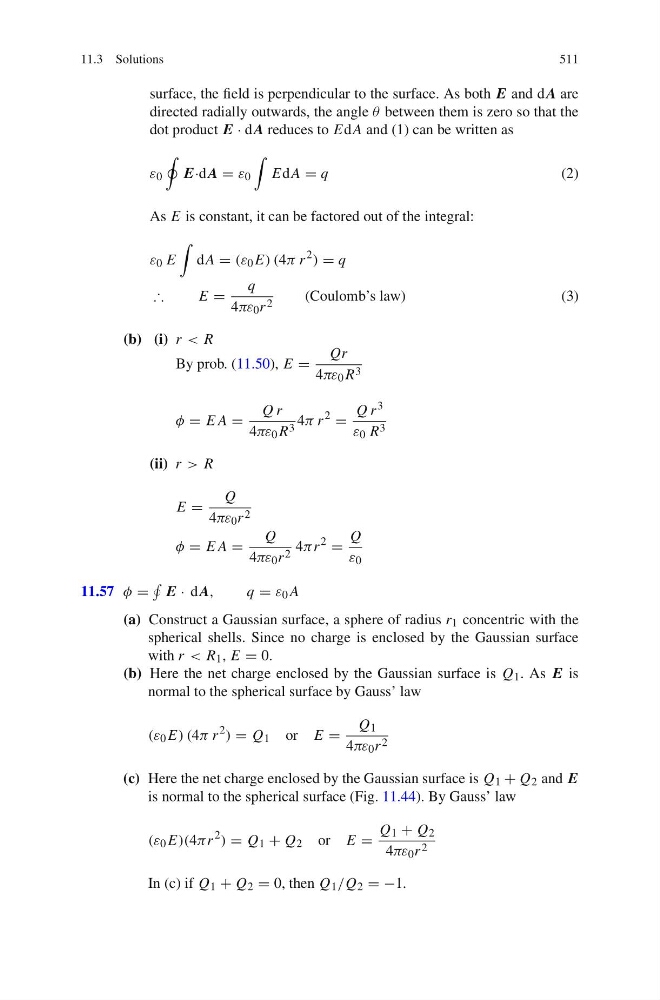
surface, the field is perpendicular to the surface. As both E and d A are
directed radially outwards, the angle θ between them is zero so that the
dot product E · d A reduces to EdA and (1) can be written as
ε 0
E·d A = ε 0
EdA = q
(2)
As E is constant, it can be factored out of the integral:
ε 0 E
dA = (ε 0 E) (4π r
2
) = q
∴
E =
q
4πε 0 r 2
(Coulomb’s law)
(3)
(b) (i) r < R
By prob. (11.50), E =
Qr
4πε 0 R 3
φ = E A =
Q r
4πε 0 R 3 4π r
2
=
Q r 3
ε 0 R 3
(ii) r > R
E =
Q
4πε 0 r 2
φ = E A =
Q
4πε 0 r 2 4πr
2
=
Q
ε 0
11.57 φ =
E · d A,
q = ε 0 A
(a) Construct a Gaussian surface, a sphere of radius r 1 concentric with the
spherical shells. Since no charge is enclosed by the Gaussian surface
with r < R 1 , E = 0.
(b) Here the net charge enclosed by the Gaussian surface is Q 1 . As E is
normal to the spherical surface by Gauss’ law
(ε 0 E) (4π r
2
) = Q 1 or E =
Q 1
4πε 0 r 2
(c) Here the net charge enclosed by the Gaussian surface is Q 1 + Q 2 and E
is normal to the spherical surface (Fig. 11.44). By Gauss’ law
(ε 0 E)(4πr
2
) = Q 1 + Q 2 or E =
Q 1 + Q 2
4πε 0 r 2
In (c) if Q 1 + Q 2 = 0, then Q 1 /Q 2 = −1.
511
surface, the field is perpendicular to the surface. As both E and d A are
directed radially outwards, the angle θ between them is zero so that the
dot product E · d A reduces to EdA and (1) can be written as
ε 0
E·d A = ε 0
EdA = q
(2)
As E is constant, it can be factored out of the integral:
ε 0 E
dA = (ε 0 E) (4π r
2
) = q
∴
E =
q
4πε 0 r 2
(Coulomb’s law)
(3)
(b) (i) r < R
By prob. (11.50), E =
Qr
4πε 0 R 3
φ = E A =
Q r
4πε 0 R 3 4π r
2
=
Q r 3
ε 0 R 3
(ii) r > R
E =
Q
4πε 0 r 2
φ = E A =
Q
4πε 0 r 2 4πr
2
=
Q
ε 0
11.57 φ =
E · d A,
q = ε 0 A
(a) Construct a Gaussian surface, a sphere of radius r 1 concentric with the
spherical shells. Since no charge is enclosed by the Gaussian surface
with r < R 1 , E = 0.
(b) Here the net charge enclosed by the Gaussian surface is Q 1 . As E is
normal to the spherical surface by Gauss’ law
(ε 0 E) (4π r
2
) = Q 1 or E =
Q 1
4πε 0 r 2
(c) Here the net charge enclosed by the Gaussian surface is Q 1 + Q 2 and E
is normal to the spherical surface (Fig. 11.44). By Gauss’ law
(ε 0 E)(4πr
2
) = Q 1 + Q 2 or E =
Q 1 + Q 2
4πε 0 r 2
In (c) if Q 1 + Q 2 = 0, then Q 1 /Q 2 = −1.