

36
1 Kinematics and Statics
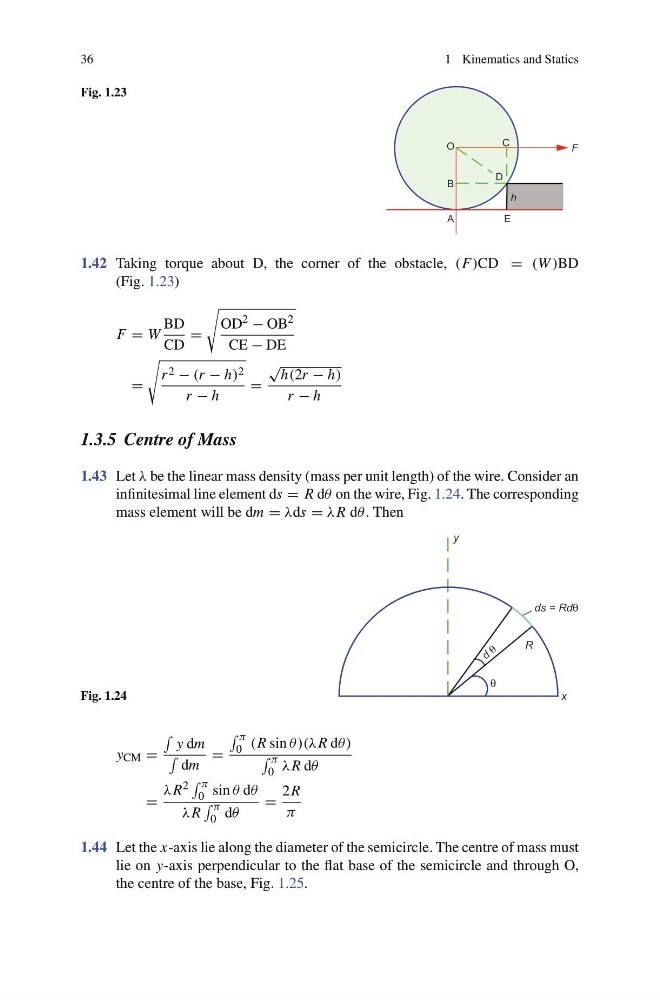
Fig. 1.23
1.42 Taking torque about D, the corner of the obstacle, (F)CD = (W )BD
(Fig. 1.23)
F = W
BD
CD
=
OD
2
− OB
2
CE − DE
=
r 2 − (r − h) 2
r − h
=
√
h(2r − h)
r − h
1.3.5 Centre of Mass
1.43 Let λ be the linear mass density (mass per unit length) of the wire. Consider an
infinitesimal line element ds = R dθ on the wire, Fig. 1.24. The corresponding
mass element will be dm = λds = λR dθ . Then
Fig. 1.24
y CM =
y dm
dm
=
π
0 (R sin θ )(λR dθ)
π
0 λR dθ
=
λR 2 π
0 sin θ dθ
λR
π
0 dθ
=
2R
π
1.44 Let the x-axis lie along the diameter of the semicircle. The centre of mass must
lie on y-axis perpendicular to the flat base of the semicircle and through O,
the centre of the base, Fig. 1.25.
1 Kinematics and Statics
Fig. 1.23
1.42 Taking torque about D, the corner of the obstacle, (F)CD = (W )BD
(Fig. 1.23)
F = W
BD
CD
=
OD
2
− OB
2
CE − DE
=
r 2 − (r − h) 2
r − h
=
√
h(2r − h)
r − h
1.3.5 Centre of Mass
1.43 Let λ be the linear mass density (mass per unit length) of the wire. Consider an
infinitesimal line element ds = R dθ on the wire, Fig. 1.24. The corresponding
mass element will be dm = λds = λR dθ . Then
Fig. 1.24
y CM =
y dm
dm
=
π
0 (R sin θ )(λR dθ)
π
0 λR dθ
=
λR 2 π
0 sin θ dθ
λR
π
0 dθ
=
2R
π
1.44 Let the x-axis lie along the diameter of the semicircle. The centre of mass must
lie on y-axis perpendicular to the flat base of the semicircle and through O,
the centre of the base, Fig. 1.25.