

11.3 Solutions
503
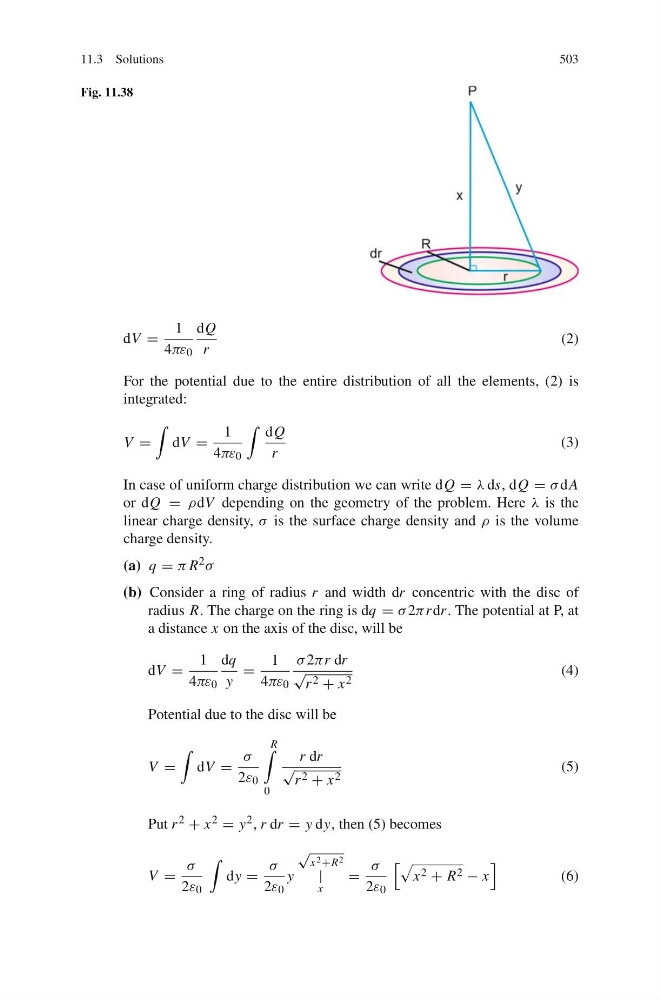
Fig. 11.38
dV =
1
4πε 0
dQ
r
(2)
For the potential due to the entire distribution of all the elements, (2) is
integrated:
V =
dV =
1
4πε 0
dQ
r
(3)
In case of uniform charge distribution we can write dQ = λ ds, dQ = σ dA
or dQ = ρdV depending on the geometry of the problem. Here λ is the
linear charge density, σ is the surface charge density and ρ is the volume
charge density.
(a) q = π R 2 σ
(b) Consider a ring of radius r and width dr concentric with the disc of
radius R. The charge on the ring is dq = σ 2πr dr . The potential at P, at
a distance x on the axis of the disc, will be
dV =
1
4πε 0
dq
y
=
1
4πε 0
σ 2πr dr
√
r 2 + x 2
(4)
Potential due to the disc will be
V =
dV =
σ
2ε 0
R
0
r dr
√
r 2 + x 2
(5)
Put r 2 + x 2 = y 2 , r dr = y dy, then (5) becomes
V =
σ
2ε 0
dy =
σ
2ε 0
y
√
x 2 +R 2
|
x
=
σ
2ε 0
x 2 + R 2 − x
(6)
503
Fig. 11.38
dV =
1
4πε 0
dQ
r
(2)
For the potential due to the entire distribution of all the elements, (2) is
integrated:
V =
dV =
1
4πε 0
dQ
r
(3)
In case of uniform charge distribution we can write dQ = λ ds, dQ = σ dA
or dQ = ρdV depending on the geometry of the problem. Here λ is the
linear charge density, σ is the surface charge density and ρ is the volume
charge density.
(a) q = π R 2 σ
(b) Consider a ring of radius r and width dr concentric with the disc of
radius R. The charge on the ring is dq = σ 2πr dr . The potential at P, at
a distance x on the axis of the disc, will be
dV =
1
4πε 0
dq
y
=
1
4πε 0
σ 2πr dr
√
r 2 + x 2
(4)
Potential due to the disc will be
V =
dV =
σ
2ε 0
R
0
r dr
√
r 2 + x 2
(5)
Put r 2 + x 2 = y 2 , r dr = y dy, then (5) becomes
V =
σ
2ε 0
dy =
σ
2ε 0
y
√
x 2 +R 2
|
x
=
σ
2ε 0
x 2 + R 2 − x
(6)