

498
11 Electrostatics
E =
E 2
x + E 2
y =
√
2 λ
4πε 0 y
tan α =
E y
E x
= 1 → α = 45
◦
Thus
E makes an angle 45 ◦ with the y-axis.
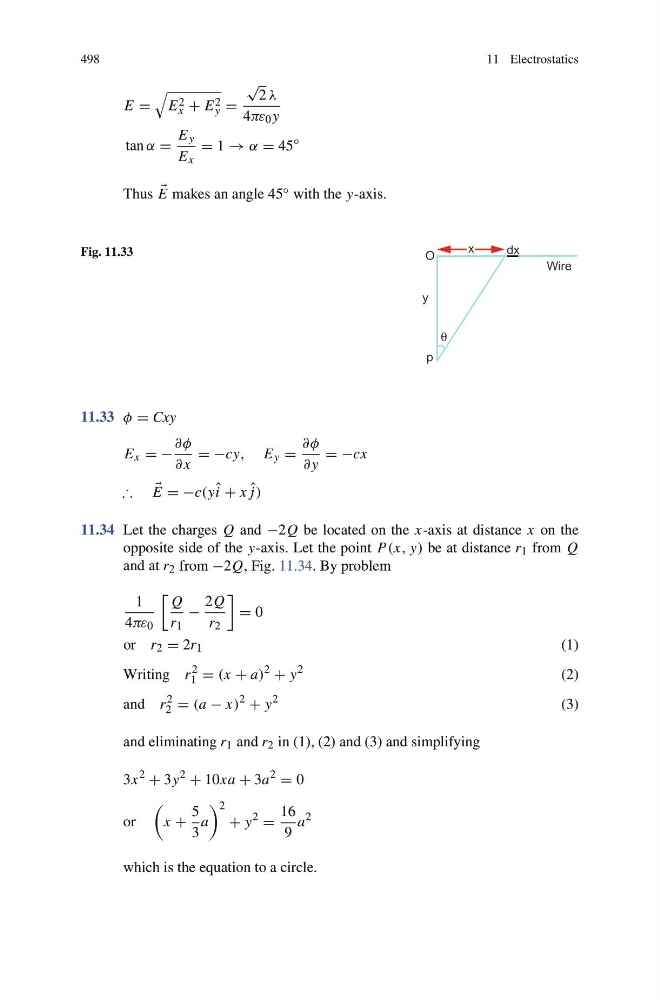
Fig. 11.33
11.33 φ = Cxy
E x = −
∂φ
∂ x
= −cy, E y =
∂φ
∂ y
= −cx
∴
E = −c(y ˆ
i + x ˆ
j)
11.34 Let the charges Q and −2Q be located on the x-axis at distance x on the
opposite side of the y-axis. Let the point P(x, y) be at distance r 1 from Q
and at r 2 from −2Q, Fig. 11.34. By problem
1
4πε 0
Q
r 1
−
2Q
r 2
= 0
or r 2 = 2r 1
(1)
Writing r
2
1 = (x + a)
2
+ y
2
(2)
and r
2
2 = (a − x)
2
+ y
2
(3)
and eliminating r 1 and r 2 in (1), (2) and (3) and simplifying
3x
2
+ 3y
2
+ 10xa + 3a
2
= 0
or
x +
5
3
a
2
+ y
2
=
16
9
a
2
which is the equation to a circle.
11 Electrostatics
E =
E 2
x + E 2
y =
√
2 λ
4πε 0 y
tan α =
E y
E x
= 1 → α = 45
◦
Thus
E makes an angle 45 ◦ with the y-axis.
Fig. 11.33
11.33 φ = Cxy
E x = −
∂φ
∂ x
= −cy, E y =
∂φ
∂ y
= −cx
∴
E = −c(y ˆ
i + x ˆ
j)
11.34 Let the charges Q and −2Q be located on the x-axis at distance x on the
opposite side of the y-axis. Let the point P(x, y) be at distance r 1 from Q
and at r 2 from −2Q, Fig. 11.34. By problem
1
4πε 0
Q
r 1
−
2Q
r 2
= 0
or r 2 = 2r 1
(1)
Writing r
2
1 = (x + a)
2
+ y
2
(2)
and r
2
2 = (a − x)
2
+ y
2
(3)
and eliminating r 1 and r 2 in (1), (2) and (3) and simplifying
3x
2
+ 3y
2
+ 10xa + 3a
2
= 0
or
x +
5
3
a
2
+ y
2
=
16
9
a
2
which is the equation to a circle.