

11.2 Problems
477
11.72 Two parallel plates, each of area 1 m 2 , are separated by a distance 0.001 m
and have a capacity of 0.1 μF. What must then the dielectric constant of the
material separating the plates be?
[University of Newcastle]
11.73 A capacitor of capacitance 5 μF is charged up to a PD of 250 V. Its terminals
are then connected to those of an uncharged capacitor of capacitance 20 μF.
What would be the resulting voltage?
[Northern Universities of UK]
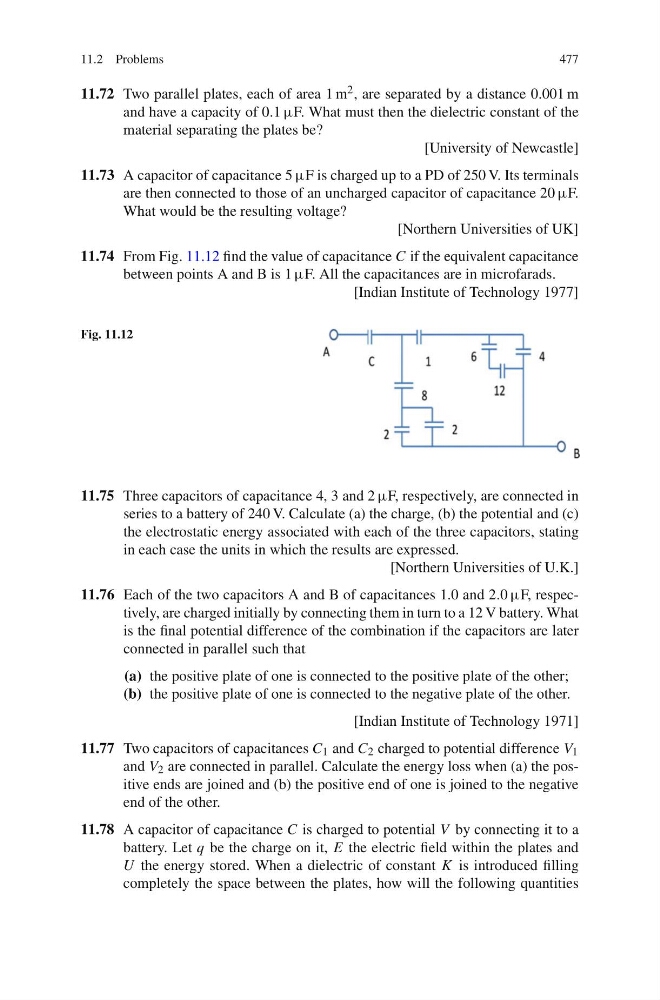
11.74 From Fig. 11.12 find the value of capacitance C if the equivalent capacitance
between points A and B is 1 μF. All the capacitances are in microfarads.
[Indian Institute of Technology 1977]
Fig. 11.12
11.75 Three capacitors of capacitance 4, 3 and 2 μF, respectively, are connected in
series to a battery of 240 V. Calculate (a) the charge, (b) the potential and (c)
the electrostatic energy associated with each of the three capacitors, stating
in each case the units in which the results are expressed.
[Northern Universities of U.K.]
11.76 Each of the two capacitors A and B of capacitances 1.0 and 2.0 μF, respectively, are charged initially by connecting them in turn to a 12 V battery. What
is the final potential difference of the combination if the capacitors are later
connected in parallel such that
(a) the positive plate of one is connected to the positive plate of the other;
(b) the positive plate of one is connected to the negative plate of the other.
[Indian Institute of Technology 1971]
11.77 Two capacitors of capacitances C 1 and C 2 charged to potential difference V 1
and V 2 are connected in parallel. Calculate the energy loss when (a) the positive ends are joined and (b) the positive end of one is joined to the negative
end of the other.
11.78 A capacitor of capacitance C is charged to potential V by connecting it to a
battery. Let q be the charge on it, E the electric field within the plates and
U the energy stored. When a dielectric of constant K is introduced filling
completely the space between the plates, how will the following quantities
477
11.72 Two parallel plates, each of area 1 m 2 , are separated by a distance 0.001 m
and have a capacity of 0.1 μF. What must then the dielectric constant of the
material separating the plates be?
[University of Newcastle]
11.73 A capacitor of capacitance 5 μF is charged up to a PD of 250 V. Its terminals
are then connected to those of an uncharged capacitor of capacitance 20 μF.
What would be the resulting voltage?
[Northern Universities of UK]
11.74 From Fig. 11.12 find the value of capacitance C if the equivalent capacitance
between points A and B is 1 μF. All the capacitances are in microfarads.
[Indian Institute of Technology 1977]
Fig. 11.12
11.75 Three capacitors of capacitance 4, 3 and 2 μF, respectively, are connected in
series to a battery of 240 V. Calculate (a) the charge, (b) the potential and (c)
the electrostatic energy associated with each of the three capacitors, stating
in each case the units in which the results are expressed.
[Northern Universities of U.K.]
11.76 Each of the two capacitors A and B of capacitances 1.0 and 2.0 μF, respectively, are charged initially by connecting them in turn to a 12 V battery. What
is the final potential difference of the combination if the capacitors are later
connected in parallel such that
(a) the positive plate of one is connected to the positive plate of the other;
(b) the positive plate of one is connected to the negative plate of the other.
[Indian Institute of Technology 1971]
11.77 Two capacitors of capacitances C 1 and C 2 charged to potential difference V 1
and V 2 are connected in parallel. Calculate the energy loss when (a) the positive ends are joined and (b) the positive end of one is joined to the negative
end of the other.
11.78 A capacitor of capacitance C is charged to potential V by connecting it to a
battery. Let q be the charge on it, E the electric field within the plates and
U the energy stored. When a dielectric of constant K is introduced filling
completely the space between the plates, how will the following quantities