

11.2 Problems
471
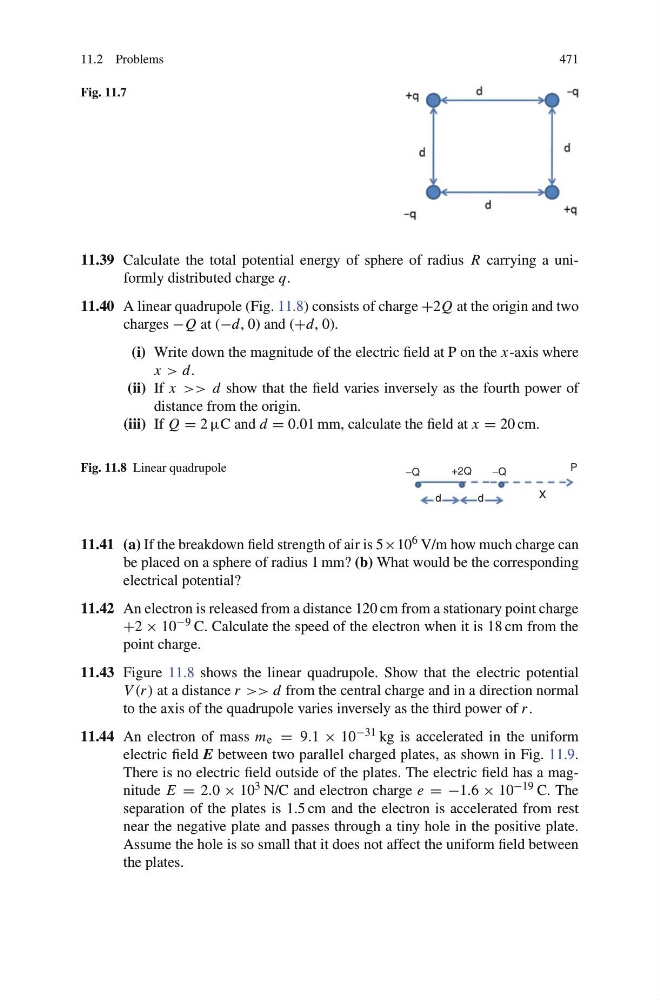
Fig. 11.7
11.39 Calculate the total potential energy of sphere of radius R carrying a uniformly distributed charge q.
11.40 A linear quadrupole (Fig. 11.8) consists of charge +2Q at the origin and two
charges −Q at (−d, 0) and (+d, 0).
(i) Write down the magnitude of the electric field at P on the x-axis where
x > d.
(ii) If x >> d show that the field varies inversely as the fourth power of
distance from the origin.
(iii) If Q = 2 μC and d = 0.01 mm, calculate the field at x = 20 cm.
Fig. 11.8 Linear quadrupole
−Q
−Q
+2Q
P
X
d
d
X
d
d
11.41 (a) If the breakdown field strength of air is 5×10 6 V/m how much charge can
be placed on a sphere of radius 1 mm? (b) What would be the corresponding
electrical potential?
11.42 An electron is released from a distance 120 cm from a stationary point charge
+2 × 10 −9 C. Calculate the speed of the electron when it is 18 cm from the
point charge.
11.43 Figure 11.8 shows the linear quadrupole. Show that the electric potential
V (r ) at a distance r >> d from the central charge and in a direction normal
to the axis of the quadrupole varies inversely as the third power of r .
11.44 An electron of mass m e = 9.1 × 10 −31 kg is accelerated in the uniform
electric field E between two parallel charged plates, as shown in Fig. 11.9.
There is no electric field outside of the plates. The electric field has a magnitude E = 2.0 × 10 3 N/C and electron charge e = −1.6 × 10 −19 C. The
separation of the plates is 1.5 cm and the electron is accelerated from rest
near the negative plate and passes through a tiny hole in the positive plate.
Assume the hole is so small that it does not affect the uniform field between
the plates.
471
Fig. 11.7
11.39 Calculate the total potential energy of sphere of radius R carrying a uniformly distributed charge q.
11.40 A linear quadrupole (Fig. 11.8) consists of charge +2Q at the origin and two
charges −Q at (−d, 0) and (+d, 0).
(i) Write down the magnitude of the electric field at P on the x-axis where
x > d.
(ii) If x >> d show that the field varies inversely as the fourth power of
distance from the origin.
(iii) If Q = 2 μC and d = 0.01 mm, calculate the field at x = 20 cm.
Fig. 11.8 Linear quadrupole
−Q
−Q
+2Q
P
X
d
d
X
d
d
11.41 (a) If the breakdown field strength of air is 5×10 6 V/m how much charge can
be placed on a sphere of radius 1 mm? (b) What would be the corresponding
electrical potential?
11.42 An electron is released from a distance 120 cm from a stationary point charge
+2 × 10 −9 C. Calculate the speed of the electron when it is 18 cm from the
point charge.
11.43 Figure 11.8 shows the linear quadrupole. Show that the electric potential
V (r ) at a distance r >> d from the central charge and in a direction normal
to the axis of the quadrupole varies inversely as the third power of r .
11.44 An electron of mass m e = 9.1 × 10 −31 kg is accelerated in the uniform
electric field E between two parallel charged plates, as shown in Fig. 11.9.
There is no electric field outside of the plates. The electric field has a magnitude E = 2.0 × 10 3 N/C and electron charge e = −1.6 × 10 −19 C. The
separation of the plates is 1.5 cm and the electron is accelerated from rest
near the negative plate and passes through a tiny hole in the positive plate.
Assume the hole is so small that it does not affect the uniform field between
the plates.