

32
1 Kinematics and Statics
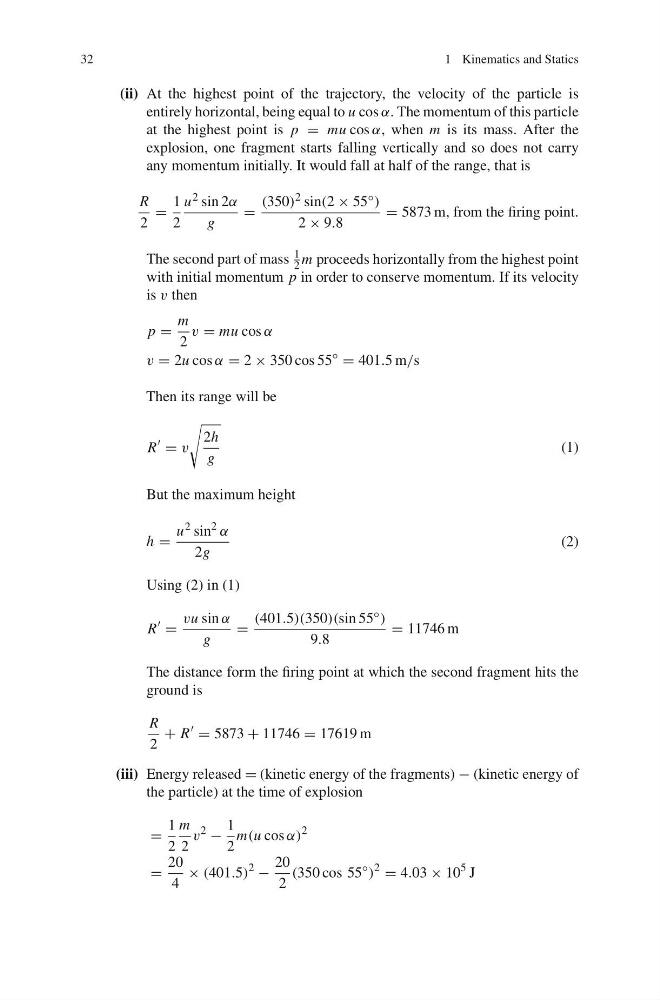
(ii) At the highest point of the trajectory, the velocity of the particle is
entirely horizontal, being equal to u cos α. The momentum of this particle
at the highest point is p = mu cos α, when m is its mass. After the
explosion, one fragment starts falling vertically and so does not carry
any momentum initially. It would fall at half of the range, that is
R
2
=
1
2
u 2 sin 2α
g
=
(350) 2 sin(2 × 55 ◦ )
2 × 9.8
= 5873 m, from the firing point.
The second part of mass
1
2 m proceeds horizontally from the highest point
with initial momentum p in order to conserve momentum. If its velocity
is v then
p =
m
2
v = mu cos α
v = 2u cos α = 2 × 350 cos 55
◦
= 401.5 m/s
Then its range will be
R
= v
2h
g
(1)
But the maximum height
h =
u 2 sin
2
α
2g
(2)
Using (2) in (1)
R
=
vu sin α
g
=
(401.5)(350)(sin 55 ◦ )
9.8
= 11746 m
The distance form the firing point at which the second fragment hits the
ground is
R
2
+ R
= 5873 + 11746 = 17619 m
(iii) Energy released = (kinetic energy of the fragments) − (kinetic energy of
the particle) at the time of explosion
=
1
2
m
2
v
2
−
1
2
m(u cos α)
2
=
20
4
× (401.5)
2
−
20
2
(350 cos 55
◦
)
2
= 4.03 × 10
5 J
1 Kinematics and Statics
(ii) At the highest point of the trajectory, the velocity of the particle is
entirely horizontal, being equal to u cos α. The momentum of this particle
at the highest point is p = mu cos α, when m is its mass. After the
explosion, one fragment starts falling vertically and so does not carry
any momentum initially. It would fall at half of the range, that is
R
2
=
1
2
u 2 sin 2α
g
=
(350) 2 sin(2 × 55 ◦ )
2 × 9.8
= 5873 m, from the firing point.
The second part of mass
1
2 m proceeds horizontally from the highest point
with initial momentum p in order to conserve momentum. If its velocity
is v then
p =
m
2
v = mu cos α
v = 2u cos α = 2 × 350 cos 55
◦
= 401.5 m/s
Then its range will be
R
= v
2h
g
(1)
But the maximum height
h =
u 2 sin
2
α
2g
(2)
Using (2) in (1)
R
=
vu sin α
g
=
(401.5)(350)(sin 55 ◦ )
9.8
= 11746 m
The distance form the firing point at which the second fragment hits the
ground is
R
2
+ R
= 5873 + 11746 = 17619 m
(iii) Energy released = (kinetic energy of the fragments) − (kinetic energy of
the particle) at the time of explosion
=
1
2
m
2
v
2
−
1
2
m(u cos α)
2
=
20
4
× (401.5)
2
−
20
2
(350 cos 55
◦
)
2
= 4.03 × 10
5 J