

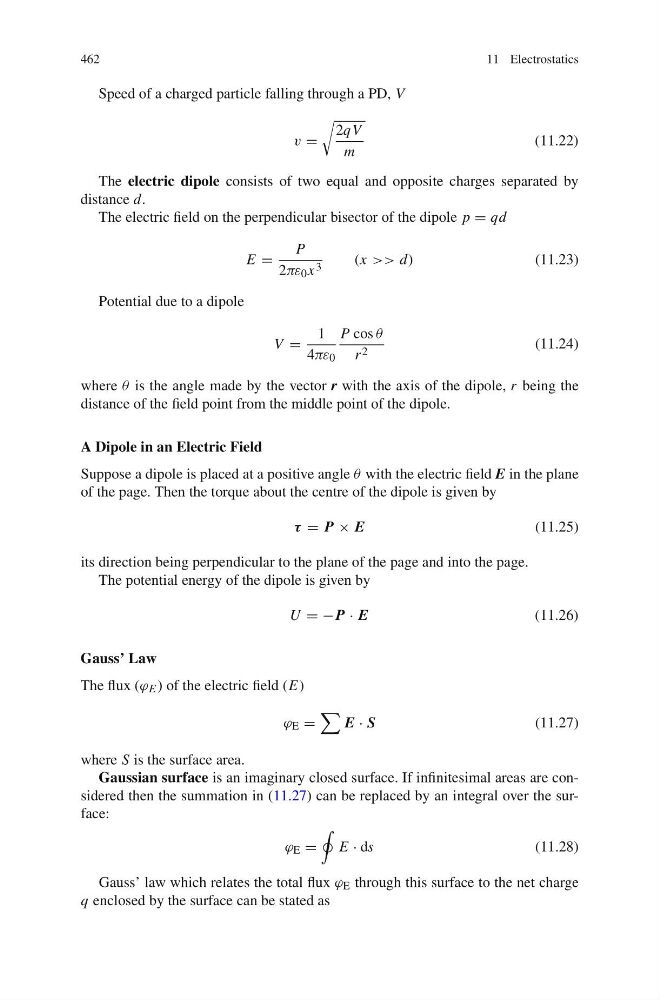
462
11 Electrostatics
Speed of a charged particle falling through a PD, V
v =
2qV
m
(11.22)
The electric dipole consists of two equal and opposite charges separated by
distance d.
The electric field on the perpendicular bisector of the dipole p = qd
E =
P
2πε 0 x 3
(x >> d)
(11.23)
Potential due to a dipole
V =
1
4πε 0
P cos θ
r 2
(11.24)
where θ is the angle made by the vector r with the axis of the dipole, r being the
distance of the field point from the middle point of the dipole.
A Dipole in an Electric Field
Suppose a dipole is placed at a positive angle θ with the electric field E in the plane
of the page. Then the torque about the centre of the dipole is given by
τ = P × E
(11.25)
its direction being perpendicular to the plane of the page and into the page.
The potential energy of the dipole is given by
U = −P · E
(11.26)
Gauss’ Law
The flux (ϕ E ) of the electric field (E)
ϕ E =
E · S
(11.27)
where S is the surface area.
Gaussian surface is an imaginary closed surface. If infinitesimal areas are considered then the summation in (11.27) can be replaced by an integral over the surface:
ϕ E =
E · ds
(11.28)
Gauss’ law which relates the total flux ϕ E through this surface to the net charge
q enclosed by the surface can be stated as
11 Electrostatics
Speed of a charged particle falling through a PD, V
v =
2qV
m
(11.22)
The electric dipole consists of two equal and opposite charges separated by
distance d.
The electric field on the perpendicular bisector of the dipole p = qd
E =
P
2πε 0 x 3
(x >> d)
(11.23)
Potential due to a dipole
V =
1
4πε 0
P cos θ
r 2
(11.24)
where θ is the angle made by the vector r with the axis of the dipole, r being the
distance of the field point from the middle point of the dipole.
A Dipole in an Electric Field
Suppose a dipole is placed at a positive angle θ with the electric field E in the plane
of the page. Then the torque about the centre of the dipole is given by
τ = P × E
(11.25)
its direction being perpendicular to the plane of the page and into the page.
The potential energy of the dipole is given by
U = −P · E
(11.26)
Gauss’ Law
The flux (ϕ E ) of the electric field (E)
ϕ E =
E · S
(11.27)
where S is the surface area.
Gaussian surface is an imaginary closed surface. If infinitesimal areas are considered then the summation in (11.27) can be replaced by an integral over the surface:
ϕ E =
E · ds
(11.28)
Gauss’ law which relates the total flux ϕ E through this surface to the net charge
q enclosed by the surface can be stated as