

10.3 Solutions
457
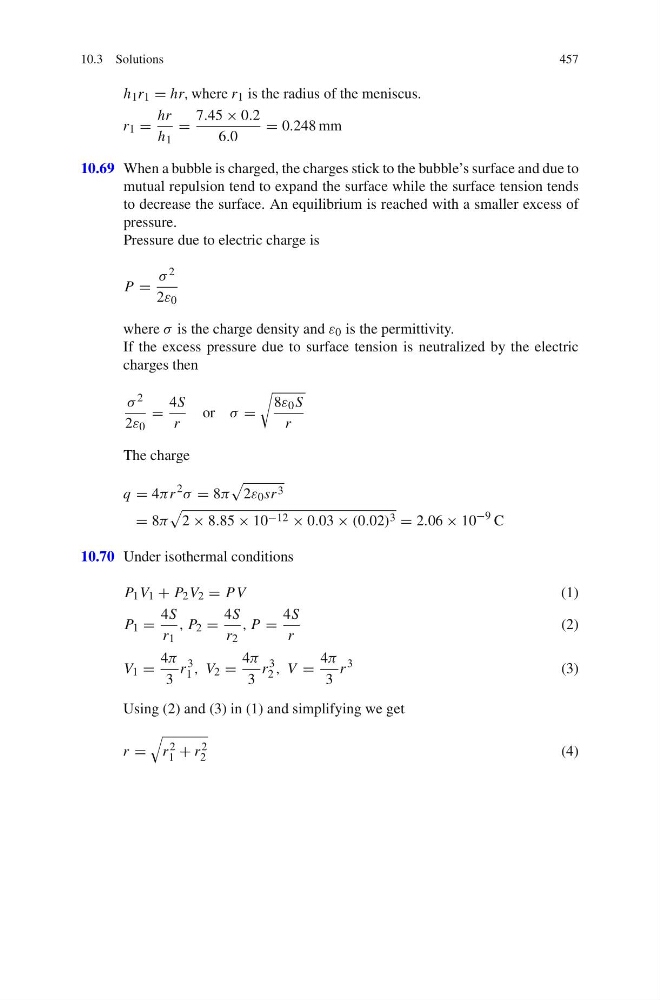
h 1 r 1 = hr, where r 1 is the radius of the meniscus.
r 1 =
hr
h 1
=
7.45 × 0.2
6.0
= 0.248 mm
10.69 When a bubble is charged, the charges stick to the bubble’s surface and due to
mutual repulsion tend to expand the surface while the surface tension tends
to decrease the surface. An equilibrium is reached with a smaller excess of
pressure.
Pressure due to electric charge is
P =
σ 2
2ε 0
where σ is the charge density and ε 0 is the permittivity.
If the excess pressure due to surface tension is neutralized by the electric
charges then
σ 2
2ε 0
=
4S
r
or σ =
8ε 0 S
r
The charge
q = 4πr
2
σ = 8π
2ε 0 sr 3
= 8π
2 × 8.85 × 10 −12 × 0.03 × (0.02) 3 = 2.06 × 10
−9 C
10.70 Under isothermal conditions
P 1 V 1 + P 2 V 2 = PV
(1)
P 1 =
4S
r 1
, P 2 =
4S
r 2
, P =
4S
r
(2)
V 1 =
4π
3
r
3
1 , V 2 =
4π
3
r
3
2 , V =
4π
3
r
3
(3)
Using (2) and (3) in (1) and simplifying we get
r =
r 2
1 + r 2
2
(4)
457
h 1 r 1 = hr, where r 1 is the radius of the meniscus.
r 1 =
hr
h 1
=
7.45 × 0.2
6.0
= 0.248 mm
10.69 When a bubble is charged, the charges stick to the bubble’s surface and due to
mutual repulsion tend to expand the surface while the surface tension tends
to decrease the surface. An equilibrium is reached with a smaller excess of
pressure.
Pressure due to electric charge is
P =
σ 2
2ε 0
where σ is the charge density and ε 0 is the permittivity.
If the excess pressure due to surface tension is neutralized by the electric
charges then
σ 2
2ε 0
=
4S
r
or σ =
8ε 0 S
r
The charge
q = 4πr
2
σ = 8π
2ε 0 sr 3
= 8π
2 × 8.85 × 10 −12 × 0.03 × (0.02) 3 = 2.06 × 10
−9 C
10.70 Under isothermal conditions
P 1 V 1 + P 2 V 2 = PV
(1)
P 1 =
4S
r 1
, P 2 =
4S
r 2
, P =
4S
r
(2)
V 1 =
4π
3
r
3
1 , V 2 =
4π
3
r
3
2 , V =
4π
3
r
3
(3)
Using (2) and (3) in (1) and simplifying we get
r =
r 2
1 + r 2
2
(4)