

454
10 Heat and Matter
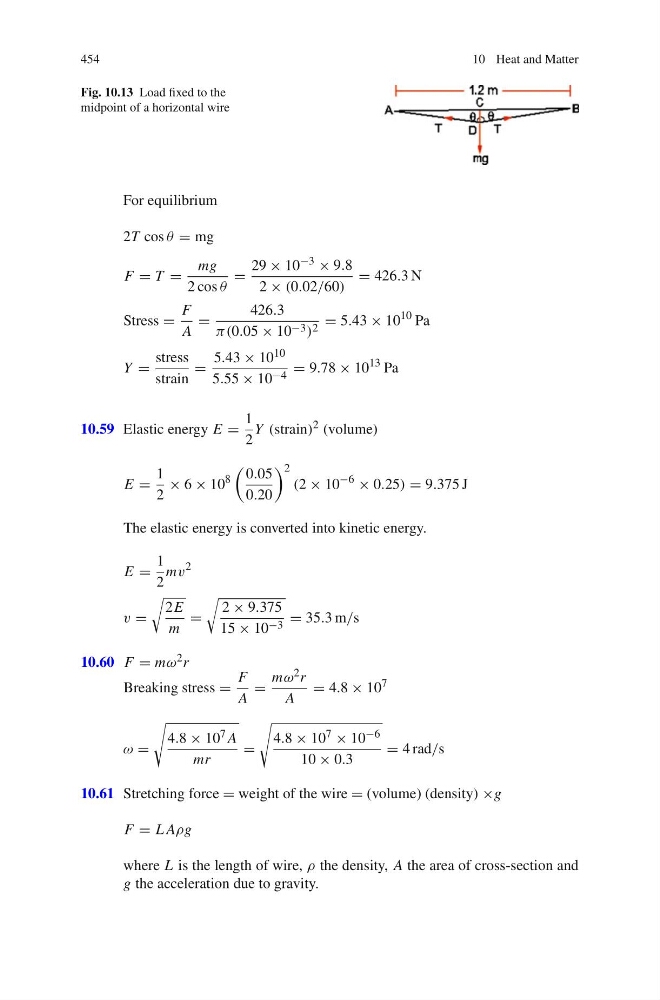
Fig. 10.13 Load fixed to the
midpoint of a horizontal wire
For equilibrium
2T cos θ = mg
F = T =
mg
2 cos θ
=
29 × 10 −3 × 9.8
2 × (0.02/60)
= 426.3 N
Stress =
F
A
=
426.3
π(0.05 × 10 −3 ) 2 = 5.43 × 10
10 Pa
Y =
stress
strain
=
5.43 × 10 10
5.55 × 10 −4 = 9.78 × 10
13 Pa
10.59 Elastic energy E =
1
2
Y (strain) 2 (volume)
E =
1
2
× 6 × 10
8
0.05
0.20
2
(2 × 10
−6
× 0.25) = 9.375 J
The elastic energy is converted into kinetic energy.
E =
1
2
mv
2
v =
2E
m
=
2 × 9.375
15 × 10 −3 = 35.3 m/s
10.60 F = mω 2 r
Breaking stress =
F
A
=
mω 2 r
A
= 4.8 × 10 7
ω =
4.8 × 10 7 A
mr
=
4.8 × 10 7 × 10 −6
10 × 0.3
= 4 rad/s
10.61 Stretching force = weight of the wire = (volume) (density) ×g
F = L Aρg
where L is the length of wire, ρ the density, A the area of cross-section and
g the acceleration due to gravity.
10 Heat and Matter
Fig. 10.13 Load fixed to the
midpoint of a horizontal wire
For equilibrium
2T cos θ = mg
F = T =
mg
2 cos θ
=
29 × 10 −3 × 9.8
2 × (0.02/60)
= 426.3 N
Stress =
F
A
=
426.3
π(0.05 × 10 −3 ) 2 = 5.43 × 10
10 Pa
Y =
stress
strain
=
5.43 × 10 10
5.55 × 10 −4 = 9.78 × 10
13 Pa
10.59 Elastic energy E =
1
2
Y (strain) 2 (volume)
E =
1
2
× 6 × 10
8
0.05
0.20
2
(2 × 10
−6
× 0.25) = 9.375 J
The elastic energy is converted into kinetic energy.
E =
1
2
mv
2
v =
2E
m
=
2 × 9.375
15 × 10 −3 = 35.3 m/s
10.60 F = mω 2 r
Breaking stress =
F
A
=
mω 2 r
A
= 4.8 × 10 7
ω =
4.8 × 10 7 A
mr
=
4.8 × 10 7 × 10 −6
10 × 0.3
= 4 rad/s
10.61 Stretching force = weight of the wire = (volume) (density) ×g
F = L Aρg
where L is the length of wire, ρ the density, A the area of cross-section and
g the acceleration due to gravity.