

442
10 Heat and Matter
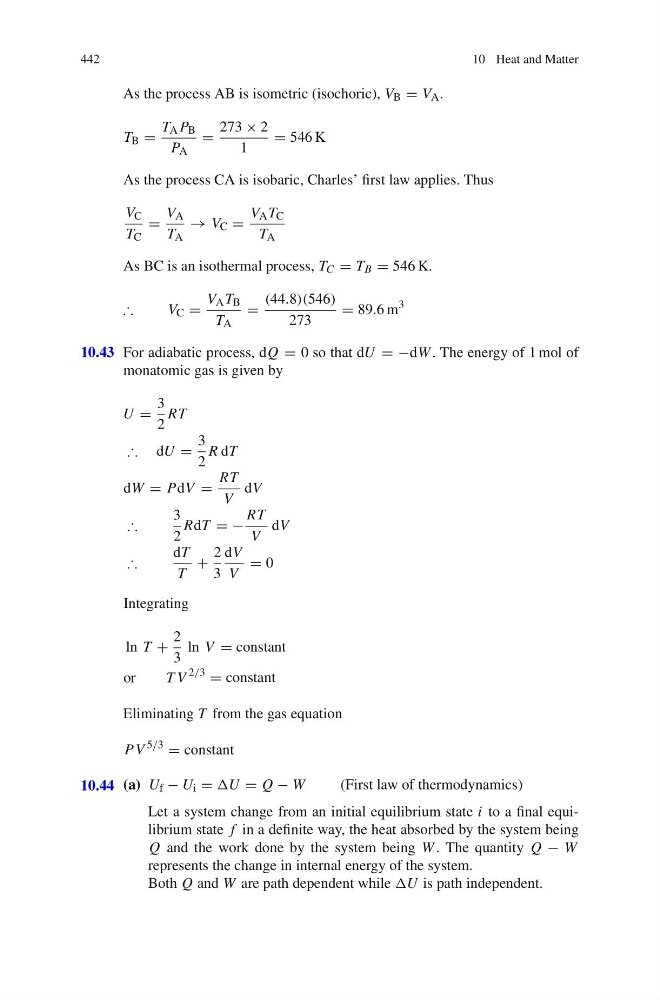
As the process AB is isometric (isochoric), V B = V A .
T B =
T A P B
P A
=
273 × 2
1
= 546 K
As the process CA is isobaric, Charles’ first law applies. Thus
V C
T C
=
V A
T A
→ V C =
V A T C
T A
As BC is an isothermal process, T C = T B = 546 K.
∴
V C =
V A T B
T A
=
(44.8)(546)
273
= 89.6 m
3
10.43 For adiabatic process, dQ = 0 so that dU = −dW . The energy of 1 mol of
monatomic gas is given by
U =
3
2
RT
∴ dU =
3
2
R dT
dW = PdV =
RT
V
dV
∴
3
2
RdT = −
RT
V
dV
∴
dT
T
+
2
3
dV
V
= 0
Integrating
ln T +
2
3
ln V = constant
or
T V
2/3
= constant
Eliminating T from the gas equation
PV
5/3
= constant
10.44 (a) U f − U i = U = Q − W
(First law of thermodynamics)
Let a system change from an initial equilibrium state i to a final equilibrium state f in a definite way, the heat absorbed by the system being
Q and the work done by the system being W . The quantity Q − W
represents the change in internal energy of the system.
Both Q and W are path dependent while U is path independent.
10 Heat and Matter
As the process AB is isometric (isochoric), V B = V A .
T B =
T A P B
P A
=
273 × 2
1
= 546 K
As the process CA is isobaric, Charles’ first law applies. Thus
V C
T C
=
V A
T A
→ V C =
V A T C
T A
As BC is an isothermal process, T C = T B = 546 K.
∴
V C =
V A T B
T A
=
(44.8)(546)
273
= 89.6 m
3
10.43 For adiabatic process, dQ = 0 so that dU = −dW . The energy of 1 mol of
monatomic gas is given by
U =
3
2
RT
∴ dU =
3
2
R dT
dW = PdV =
RT
V
dV
∴
3
2
RdT = −
RT
V
dV
∴
dT
T
+
2
3
dV
V
= 0
Integrating
ln T +
2
3
ln V = constant
or
T V
2/3
= constant
Eliminating T from the gas equation
PV
5/3
= constant
10.44 (a) U f − U i = U = Q − W
(First law of thermodynamics)
Let a system change from an initial equilibrium state i to a final equilibrium state f in a definite way, the heat absorbed by the system being
Q and the work done by the system being W . The quantity Q − W
represents the change in internal energy of the system.
Both Q and W are path dependent while U is path independent.