

438
10 Heat and Matter
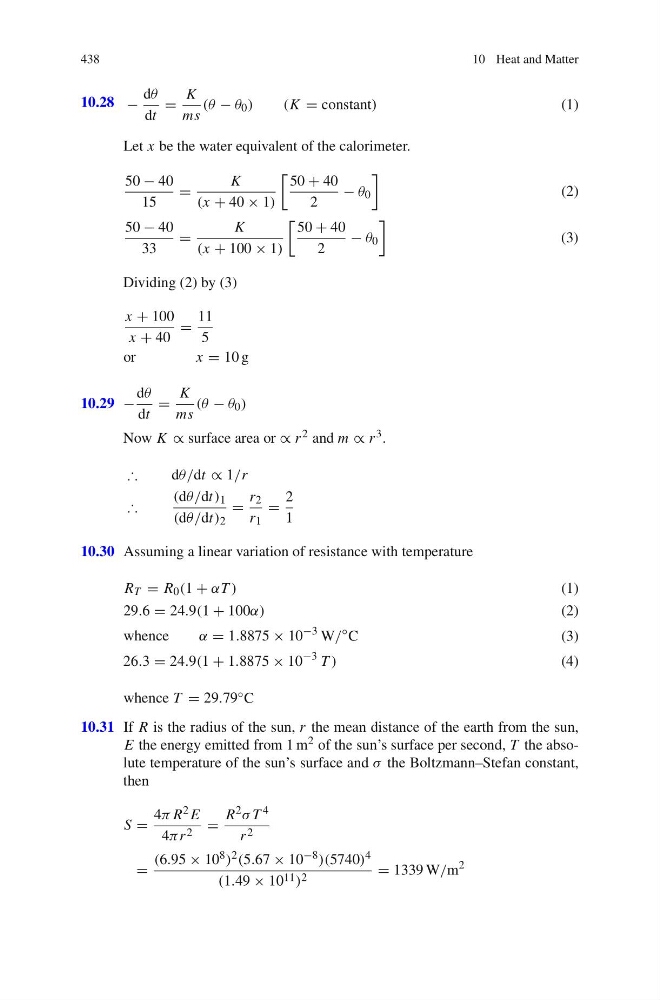
10.28 −
dθ
dt
=
K
ms
(θ − θ 0 )
(K = constant)
(1)
Let x be the water equivalent of the calorimeter.
50 − 40
15
=
K
(x + 40 × 1)
50 + 40
2
− θ 0
(2)
50 − 40
33
=
K
(x + 100 × 1)
50 + 40
2
− θ 0
(3)
Dividing (2) by (3)
x + 100
x + 40
=
11
5
or
x = 10 g
10.29 −
dθ
dt
=
K
ms
(θ − θ 0 )
Now K ∝ surface area or ∝ r 2 and m ∝ r 3 .
∴
dθ/dt ∝ 1/r
∴
(dθ/dt) 1
(dθ/dt) 2
=
r 2
r 1
=
2
1
10.30 Assuming a linear variation of resistance with temperature
R T = R 0 (1 + αT )
(1)
29.6 = 24.9(1 + 100α)
(2)
whence
α = 1.8875 × 10
−3 W/
◦ C
( 3 )
26.3 = 24.9(1 + 1.8875 × 10
−3 T )
(4)
whence T = 29.79 ◦ C
10.31 If R is the radius of the sun, r the mean distance of the earth from the sun,
E the energy emitted from 1 m 2 of the sun’s surface per second, T the absolute temperature of the sun’s surface and σ the Boltzmann–Stefan constant,
then
S =
4π R 2 E
4πr 2 =
R 2 σ T 4
r 2
=
(6.95 × 10 8 ) 2 (5.67 × 10 −8 )(5740) 4
(1.49 × 10 11 ) 2
= 1339 W/m
2
10 Heat and Matter
10.28 −
dθ
dt
=
K
ms
(θ − θ 0 )
(K = constant)
(1)
Let x be the water equivalent of the calorimeter.
50 − 40
15
=
K
(x + 40 × 1)
50 + 40
2
− θ 0
(2)
50 − 40
33
=
K
(x + 100 × 1)
50 + 40
2
− θ 0
(3)
Dividing (2) by (3)
x + 100
x + 40
=
11
5
or
x = 10 g
10.29 −
dθ
dt
=
K
ms
(θ − θ 0 )
Now K ∝ surface area or ∝ r 2 and m ∝ r 3 .
∴
dθ/dt ∝ 1/r
∴
(dθ/dt) 1
(dθ/dt) 2
=
r 2
r 1
=
2
1
10.30 Assuming a linear variation of resistance with temperature
R T = R 0 (1 + αT )
(1)
29.6 = 24.9(1 + 100α)
(2)
whence
α = 1.8875 × 10
−3 W/
◦ C
( 3 )
26.3 = 24.9(1 + 1.8875 × 10
−3 T )
(4)
whence T = 29.79 ◦ C
10.31 If R is the radius of the sun, r the mean distance of the earth from the sun,
E the energy emitted from 1 m 2 of the sun’s surface per second, T the absolute temperature of the sun’s surface and σ the Boltzmann–Stefan constant,
then
S =
4π R 2 E
4πr 2 =
R 2 σ T 4
r 2
=
(6.95 × 10 8 ) 2 (5.67 × 10 −8 )(5740) 4
(1.49 × 10 11 ) 2
= 1339 W/m
2