

1.3 Solutions
29
Using (2) and (3) in (1) and simplifying
R =
2u 2 cos θ sin(θ − α)
g cos 2 α
The maximum range is obtained by setting
dR
dθ
= 0, holding u, α and g
constant. This gives cos(2θ − α) = 0 or 2θ − α =
π
2
∴ α =
θ
2
+
π
4
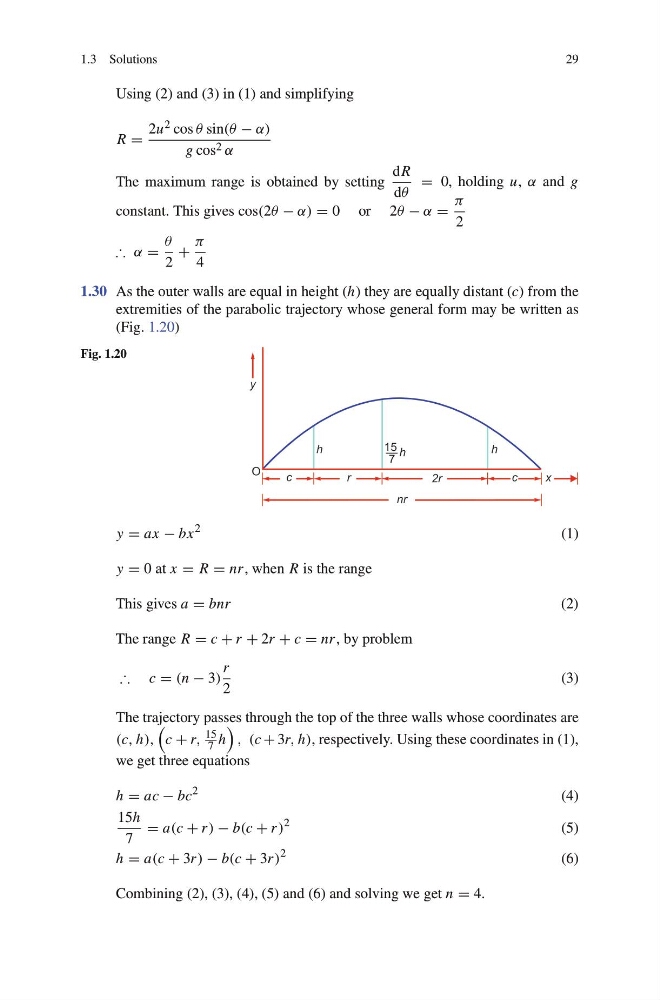
1.30 As the outer walls are equal in height (h) they are equally distant (c) from the
extremities of the parabolic trajectory whose general form may be written as
(Fig. 1.20)
Fig. 1.20
y = ax − bx
2
(1)
y = 0 at x = R = nr, when R is the range
This gives a = bnr
(2)
The range R = c + r + 2r + c = nr, by problem
∴ c = (n − 3)
r
2
(3)
The trajectory passes through the top of the three walls whose coordinates are
(c, h),
c + r,
15
7 h
, (c + 3r, h), respectively. Using these coordinates in (1),
we get three equations
h = ac − bc
2
(4)
15h
7
= a(c + r ) − b(c + r )
2
(5)
h = a(c + 3r ) − b(c + 3r )
2
(6)
Combining (2), (3), (4), (5) and (6) and solving we get n = 4.
29
Using (2) and (3) in (1) and simplifying
R =
2u 2 cos θ sin(θ − α)
g cos 2 α
The maximum range is obtained by setting
dR
dθ
= 0, holding u, α and g
constant. This gives cos(2θ − α) = 0 or 2θ − α =
π
2
∴ α =
θ
2
+
π
4
1.30 As the outer walls are equal in height (h) they are equally distant (c) from the
extremities of the parabolic trajectory whose general form may be written as
(Fig. 1.20)
Fig. 1.20
y = ax − bx
2
(1)
y = 0 at x = R = nr, when R is the range
This gives a = bnr
(2)
The range R = c + r + 2r + c = nr, by problem
∴ c = (n − 3)
r
2
(3)
The trajectory passes through the top of the three walls whose coordinates are
(c, h),
c + r,
15
7 h
, (c + 3r, h), respectively. Using these coordinates in (1),
we get three equations
h = ac − bc
2
(4)
15h
7
= a(c + r ) − b(c + r )
2
(5)
h = a(c + 3r ) − b(c + 3r )
2
(6)
Combining (2), (3), (4), (5) and (6) and solving we get n = 4.