

424
10 Heat and Matter
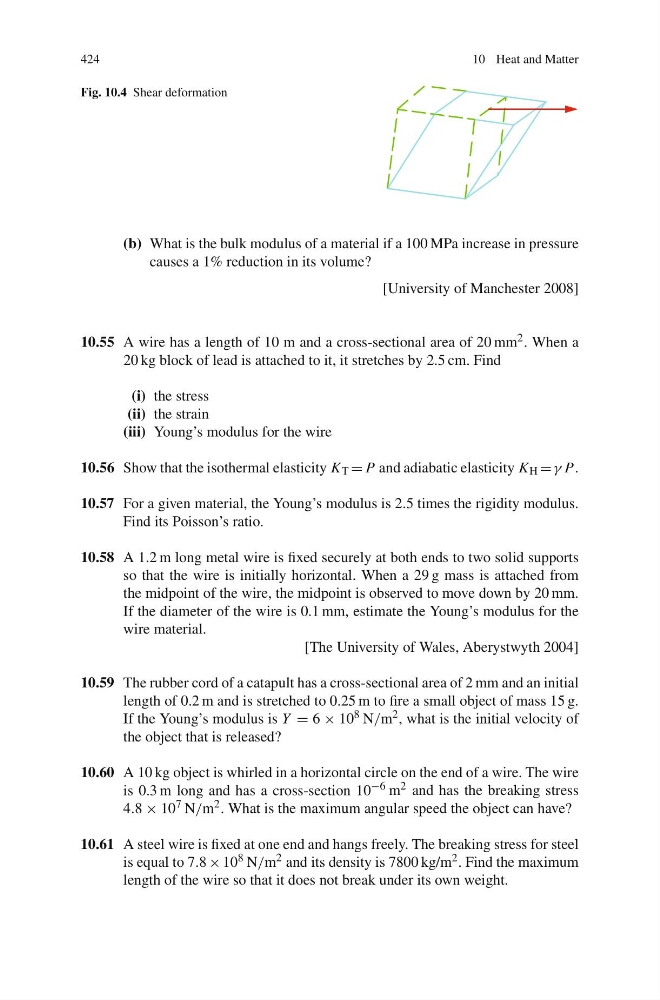
Fig. 10.4 Shear deformation
(b) What is the bulk modulus of a material if a 100 MPa increase in pressure
causes a 1% reduction in its volume?
[University of Manchester 2008]
10.55 A wire has a length of 10 m and a cross-sectional area of 20 mm 2 . When a
20 kg block of lead is attached to it, it stretches by 2.5 cm. Find
(i) the stress
(ii) the strain
(iii) Young’s modulus for the wire
10.56 Show that the isothermal elasticity K T = P and adiabatic elasticity K H = γ P.
10.57 For a given material, the Young’s modulus is 2.5 times the rigidity modulus.
Find its Poisson’s ratio.
10.58 A 1.2 m long metal wire is fixed securely at both ends to two solid supports
so that the wire is initially horizontal. When a 29 g mass is attached from
the midpoint of the wire, the midpoint is observed to move down by 20 mm.
If the diameter of the wire is 0.1 mm, estimate the Young’s modulus for the
wire material.
[The University of Wales, Aberystwyth 2004]
10.59 The rubber cord of a catapult has a cross-sectional area of 2 mm and an initial
length of 0.2 m and is stretched to 0.25 m to fire a small object of mass 15 g.
If the Young’s modulus is Y = 6 × 10 8 N/m 2 , what is the initial velocity of
the object that is released?
10.60 A 10 kg object is whirled in a horizontal circle on the end of a wire. The wire
is 0.3 m long and has a cross-section 10 −6 m 2 and has the breaking stress
4.8 × 10 7 N/m 2 . What is the maximum angular speed the object can have?
10.61 A steel wire is fixed at one end and hangs freely. The breaking stress for steel
is equal to 7.8 × 10 8 N/m 2 and its density is 7800 kg/m 2 . Find the maximum
length of the wire so that it does not break under its own weight.
10 Heat and Matter
Fig. 10.4 Shear deformation
(b) What is the bulk modulus of a material if a 100 MPa increase in pressure
causes a 1% reduction in its volume?
[University of Manchester 2008]
10.55 A wire has a length of 10 m and a cross-sectional area of 20 mm 2 . When a
20 kg block of lead is attached to it, it stretches by 2.5 cm. Find
(i) the stress
(ii) the strain
(iii) Young’s modulus for the wire
10.56 Show that the isothermal elasticity K T = P and adiabatic elasticity K H = γ P.
10.57 For a given material, the Young’s modulus is 2.5 times the rigidity modulus.
Find its Poisson’s ratio.
10.58 A 1.2 m long metal wire is fixed securely at both ends to two solid supports
so that the wire is initially horizontal. When a 29 g mass is attached from
the midpoint of the wire, the midpoint is observed to move down by 20 mm.
If the diameter of the wire is 0.1 mm, estimate the Young’s modulus for the
wire material.
[The University of Wales, Aberystwyth 2004]
10.59 The rubber cord of a catapult has a cross-sectional area of 2 mm and an initial
length of 0.2 m and is stretched to 0.25 m to fire a small object of mass 15 g.
If the Young’s modulus is Y = 6 × 10 8 N/m 2 , what is the initial velocity of
the object that is released?
10.60 A 10 kg object is whirled in a horizontal circle on the end of a wire. The wire
is 0.3 m long and has a cross-section 10 −6 m 2 and has the breaking stress
4.8 × 10 7 N/m 2 . What is the maximum angular speed the object can have?
10.61 A steel wire is fixed at one end and hangs freely. The breaking stress for steel
is equal to 7.8 × 10 8 N/m 2 and its density is 7800 kg/m 2 . Find the maximum
length of the wire so that it does not break under its own weight.