

10.2 Problems
421
(iii) an adiabatic process
(iv) an isothermal process
(b) Show that the work done on a gas during an adiabatic compression from
initial conditions (P 1 , V 1 ) to final conditions (P 2 , V 2 ) is given by the
equation
W =
1
γ − 1
( p 2 V 2 − p 1 V 1 )
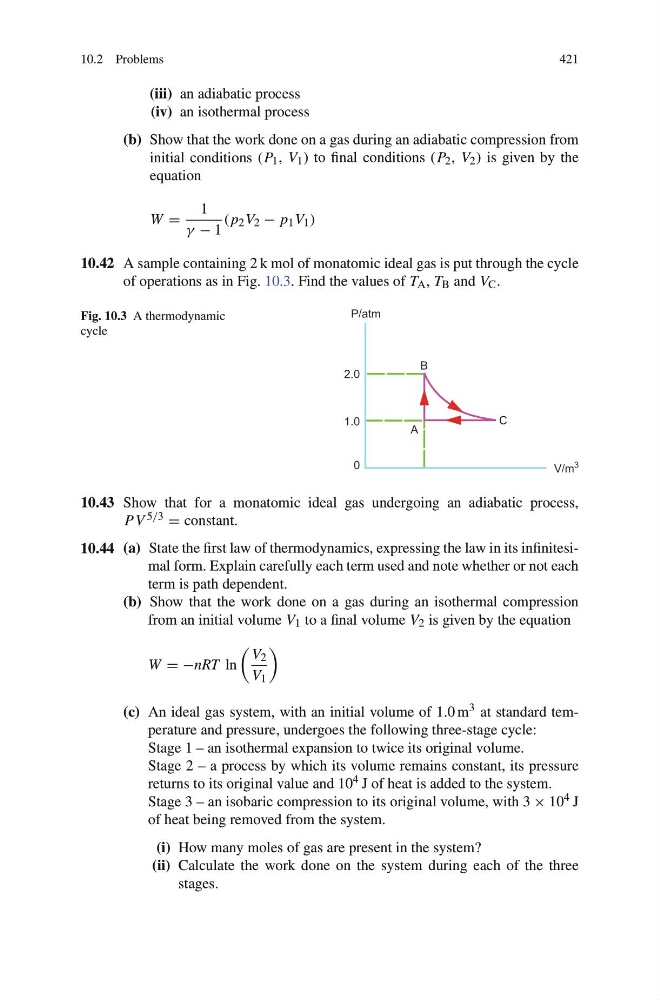
10.42 A sample containing 2 k mol of monatomic ideal gas is put through the cycle
of operations as in Fig. 10.3. Find the values of T A , T B and V C .
Fig. 10.3 A thermodynamic
cycle
10.43 Show that for a monatomic ideal gas undergoing an adiabatic process,
PV 5/3 = constant.
10.44 (a) State the first law of thermodynamics, expressing the law in its infinitesimal form. Explain carefully each term used and note whether or not each
term is path dependent.
(b) Show that the work done on a gas during an isothermal compression
from an initial volume V 1 to a final volume V 2 is given by the equation
W = −nRT ln
V 2
V 1
(c) An ideal gas system, with an initial volume of 1.0 m 3 at standard temperature and pressure, undergoes the following three-stage cycle:
Stage 1 – an isothermal expansion to twice its original volume.
Stage 2 – a process by which its volume remains constant, its pressure
returns to its original value and 10 4 J of heat is added to the system.
Stage 3 – an isobaric compression to its original volume, with 3 × 10 4 J
of heat being removed from the system.
(i) How many moles of gas are present in the system?
(ii) Calculate the work done on the system during each of the three
stages.
421
(iii) an adiabatic process
(iv) an isothermal process
(b) Show that the work done on a gas during an adiabatic compression from
initial conditions (P 1 , V 1 ) to final conditions (P 2 , V 2 ) is given by the
equation
W =
1
γ − 1
( p 2 V 2 − p 1 V 1 )
10.42 A sample containing 2 k mol of monatomic ideal gas is put through the cycle
of operations as in Fig. 10.3. Find the values of T A , T B and V C .
Fig. 10.3 A thermodynamic
cycle
10.43 Show that for a monatomic ideal gas undergoing an adiabatic process,
PV 5/3 = constant.
10.44 (a) State the first law of thermodynamics, expressing the law in its infinitesimal form. Explain carefully each term used and note whether or not each
term is path dependent.
(b) Show that the work done on a gas during an isothermal compression
from an initial volume V 1 to a final volume V 2 is given by the equation
W = −nRT ln
V 2
V 1
(c) An ideal gas system, with an initial volume of 1.0 m 3 at standard temperature and pressure, undergoes the following three-stage cycle:
Stage 1 – an isothermal expansion to twice its original volume.
Stage 2 – a process by which its volume remains constant, its pressure
returns to its original value and 10 4 J of heat is added to the system.
Stage 3 – an isobaric compression to its original volume, with 3 × 10 4 J
of heat being removed from the system.
(i) How many moles of gas are present in the system?
(ii) Calculate the work done on the system during each of the three
stages.