

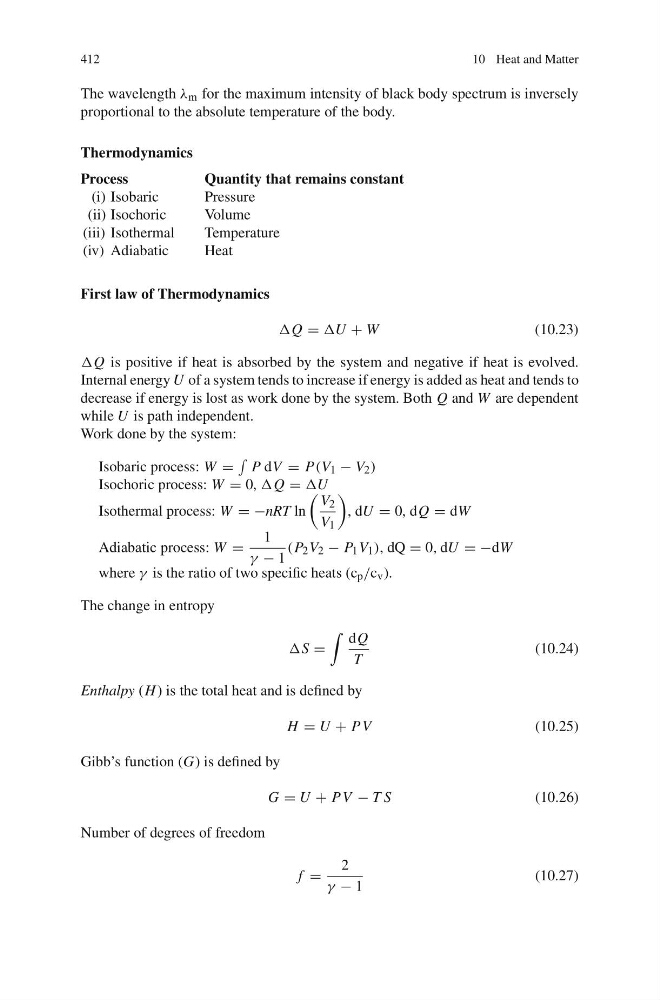
412
10 Heat and Matter
The wavelength λ m for the maximum intensity of black body spectrum is inversely
proportional to the absolute temperature of the body.
Thermodynamics
Process
Quantity that remains constant
(i) Isobaric
Pressure
(ii) Isochoric
Volume
(iii) Isothermal
Temperature
(iv) Adiabatic
Heat
First law of Thermodynamics
Q = U + W
(10.23)
Q is positive if heat is absorbed by the system and negative if heat is evolved.
Internal energy U of a system tends to increase if energy is added as heat and tends to
decrease if energy is lost as work done by the system. Both Q and W are dependent
while U is path independent.
Work done by the system:
Isobaric process: W =
P dV = P(V 1 − V 2 )
Isochoric process: W = 0, Q = U
Isothermal process: W = −nRT ln
V 2
V 1
, dU = 0, dQ = dW
Adiabatic process: W =
1
γ − 1
(P 2 V 2 − P 1 V 1 ), dQ = 0, dU = −dW
where γ is the ratio of two specific heats (c p /c v ).
The change in entropy
S =
dQ
T
(10.24)
Enthalpy (H ) is the total heat and is defined by
H = U + PV
(10.25)
Gibb’s function (G) is defined by
G = U + PV − T S
(10.26)
Number of degrees of freedom
f =
2
γ − 1
(10.27)
10 Heat and Matter
The wavelength λ m for the maximum intensity of black body spectrum is inversely
proportional to the absolute temperature of the body.
Thermodynamics
Process
Quantity that remains constant
(i) Isobaric
Pressure
(ii) Isochoric
Volume
(iii) Isothermal
Temperature
(iv) Adiabatic
Heat
First law of Thermodynamics
Q = U + W
(10.23)
Q is positive if heat is absorbed by the system and negative if heat is evolved.
Internal energy U of a system tends to increase if energy is added as heat and tends to
decrease if energy is lost as work done by the system. Both Q and W are dependent
while U is path independent.
Work done by the system:
Isobaric process: W =
P dV = P(V 1 − V 2 )
Isochoric process: W = 0, Q = U
Isothermal process: W = −nRT ln
V 2
V 1
, dU = 0, dQ = dW
Adiabatic process: W =
1
γ − 1
(P 2 V 2 − P 1 V 1 ), dQ = 0, dU = −dW
where γ is the ratio of two specific heats (c p /c v ).
The change in entropy
S =
dQ
T
(10.24)
Enthalpy (H ) is the total heat and is defined by
H = U + PV
(10.25)
Gibb’s function (G) is defined by
G = U + PV − T S
(10.26)
Number of degrees of freedom
f =
2
γ − 1
(10.27)