

408
9 Fluid Dynamics
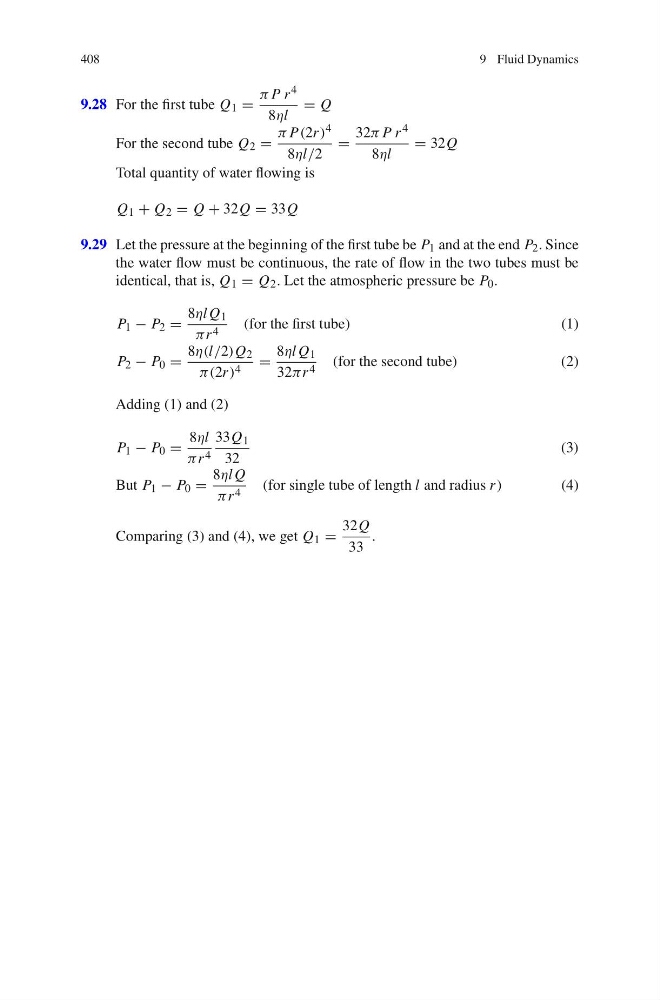
9.28 For the first tube Q 1 =
π P r 4
8ηl
= Q
For the second tube Q 2 =
π P(2r ) 4
8ηl/2
=
32π P r 4
8ηl
= 32Q
Total quantity of water flowing is
Q 1 + Q 2 = Q + 32Q = 33Q
9.29 Let the pressure at the beginning of the first tube be P 1 and at the end P 2 . Since
the water flow must be continuous, the rate of flow in the two tubes must be
identical, that is, Q 1 = Q 2 . Let the atmospheric pressure be P 0 .
P 1 − P 2 =
8ηl Q 1
πr 4
(for the first tube)
(1)
P 2 − P 0 =
8η(l/2)Q 2
π(2r ) 4 =
8ηl Q 1
32πr 4 (for the second tube)
(2)
Adding (1) and (2)
P 1 − P 0 =
8ηl
πr 4
33Q 1
32
(3)
But P 1 − P 0 =
8ηl Q
πr 4 (for single tube of length l and radius r )
( 4 )
Comparing (3) and (4), we get Q 1 =
32Q
33
.
9 Fluid Dynamics
9.28 For the first tube Q 1 =
π P r 4
8ηl
= Q
For the second tube Q 2 =
π P(2r ) 4
8ηl/2
=
32π P r 4
8ηl
= 32Q
Total quantity of water flowing is
Q 1 + Q 2 = Q + 32Q = 33Q
9.29 Let the pressure at the beginning of the first tube be P 1 and at the end P 2 . Since
the water flow must be continuous, the rate of flow in the two tubes must be
identical, that is, Q 1 = Q 2 . Let the atmospheric pressure be P 0 .
P 1 − P 2 =
8ηl Q 1
πr 4
(for the first tube)
(1)
P 2 − P 0 =
8η(l/2)Q 2
π(2r ) 4 =
8ηl Q 1
32πr 4 (for the second tube)
(2)
Adding (1) and (2)
P 1 − P 0 =
8ηl
πr 4
33Q 1
32
(3)
But P 1 − P 0 =
8ηl Q
πr 4 (for single tube of length l and radius r )
( 4 )
Comparing (3) and (4), we get Q 1 =
32Q
33
.