

402
9 Fluid Dynamics
9.15 (a) The components of mω 2 r parallel to the x-axis and z-axis are mω 2 x and
mω 2 z, respectively. Taking y in the upward direction
d p = ρ(ω
2 xdx + ω
2 zdz − gdy)
(1)
In the x − z-plane, y = constant. Hence dy = 0.
Integrating (1)
p =
ρω 2 x 2
2
+
ρω 2 z 2
2
+ C
where C is the constant of integration.
p =
ρω 2
2
(x
2
+ z
2
) + C
=
1
2
ω
2 r
2
+ C
p = p 0 at r = 0, then C = p 0
∴ p = p 0 +
1
2
ρω
2 r
2
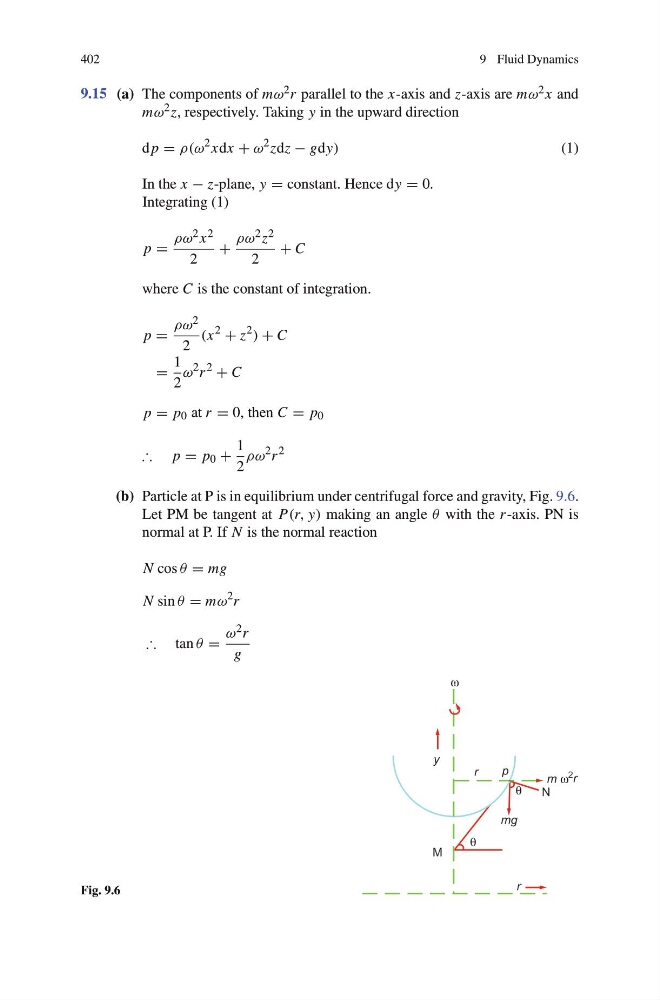
(b) Particle at P is in equilibrium under centrifugal force and gravity, Fig. 9.6.
Let PM be tangent at P(r, y) making an angle θ with the r -axis. PN is
normal at P. If N is the normal reaction
N cos θ = mg
N sin θ = mω
2 r
∴ tan θ =
ω 2 r
g
Fig. 9.6
9 Fluid Dynamics
9.15 (a) The components of mω 2 r parallel to the x-axis and z-axis are mω 2 x and
mω 2 z, respectively. Taking y in the upward direction
d p = ρ(ω
2 xdx + ω
2 zdz − gdy)
(1)
In the x − z-plane, y = constant. Hence dy = 0.
Integrating (1)
p =
ρω 2 x 2
2
+
ρω 2 z 2
2
+ C
where C is the constant of integration.
p =
ρω 2
2
(x
2
+ z
2
) + C
=
1
2
ω
2 r
2
+ C
p = p 0 at r = 0, then C = p 0
∴ p = p 0 +
1
2
ρω
2 r
2
(b) Particle at P is in equilibrium under centrifugal force and gravity, Fig. 9.6.
Let PM be tangent at P(r, y) making an angle θ with the r -axis. PN is
normal at P. If N is the normal reaction
N cos θ = mg
N sin θ = mω
2 r
∴ tan θ =
ω 2 r
g
Fig. 9.6