

9.2 Problems
395
Calculate the Reynold’s number and test at which of these three temperatures
is the flow likely to be streamlined. Assume that for Reynold’s number R <
2200 flow is steady.
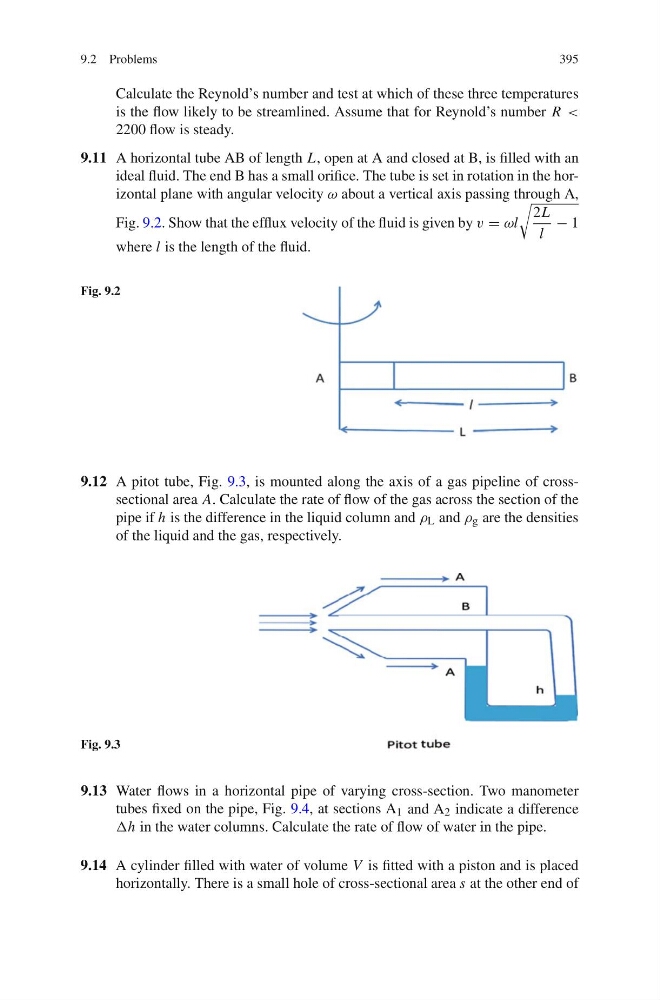
9.11 A horizontal tube AB of length L, open at A and closed at B, is filled with an
ideal fluid. The end B has a small orifice. The tube is set in rotation in the horizontal plane with angular velocity ω about a vertical axis passing through A,
Fig. 9.2. Show that the efflux velocity of the fluid is given by v = ωl
2L
l
− 1
where l is the length of the fluid.
Fig. 9.2
9.12 A pitot tube, Fig. 9.3, is mounted along the axis of a gas pipeline of crosssectional area A. Calculate the rate of flow of the gas across the section of the
pipe if h is the difference in the liquid column and ρ L and ρ g are the densities
of the liquid and the gas, respectively.
Fig. 9.3
9.13 Water flows in a horizontal pipe of varying cross-section. Two manometer
tubes fixed on the pipe, Fig. 9.4, at sections A 1 and A 2 indicate a difference
h in the water columns. Calculate the rate of flow of water in the pipe.
9.14 A cylinder filled with water of volume V is fitted with a piston and is placed
horizontally. There is a small hole of cross-sectional area s at the other end of
395
Calculate the Reynold’s number and test at which of these three temperatures
is the flow likely to be streamlined. Assume that for Reynold’s number R <
2200 flow is steady.
9.11 A horizontal tube AB of length L, open at A and closed at B, is filled with an
ideal fluid. The end B has a small orifice. The tube is set in rotation in the horizontal plane with angular velocity ω about a vertical axis passing through A,
Fig. 9.2. Show that the efflux velocity of the fluid is given by v = ωl
2L
l
− 1
where l is the length of the fluid.
Fig. 9.2
9.12 A pitot tube, Fig. 9.3, is mounted along the axis of a gas pipeline of crosssectional area A. Calculate the rate of flow of the gas across the section of the
pipe if h is the difference in the liquid column and ρ L and ρ g are the densities
of the liquid and the gas, respectively.
Fig. 9.3
9.13 Water flows in a horizontal pipe of varying cross-section. Two manometer
tubes fixed on the pipe, Fig. 9.4, at sections A 1 and A 2 indicate a difference
h in the water columns. Calculate the rate of flow of water in the pipe.
9.14 A cylinder filled with water of volume V is fitted with a piston and is placed
horizontally. There is a small hole of cross-sectional area s at the other end of