

1.3 Solutions
25
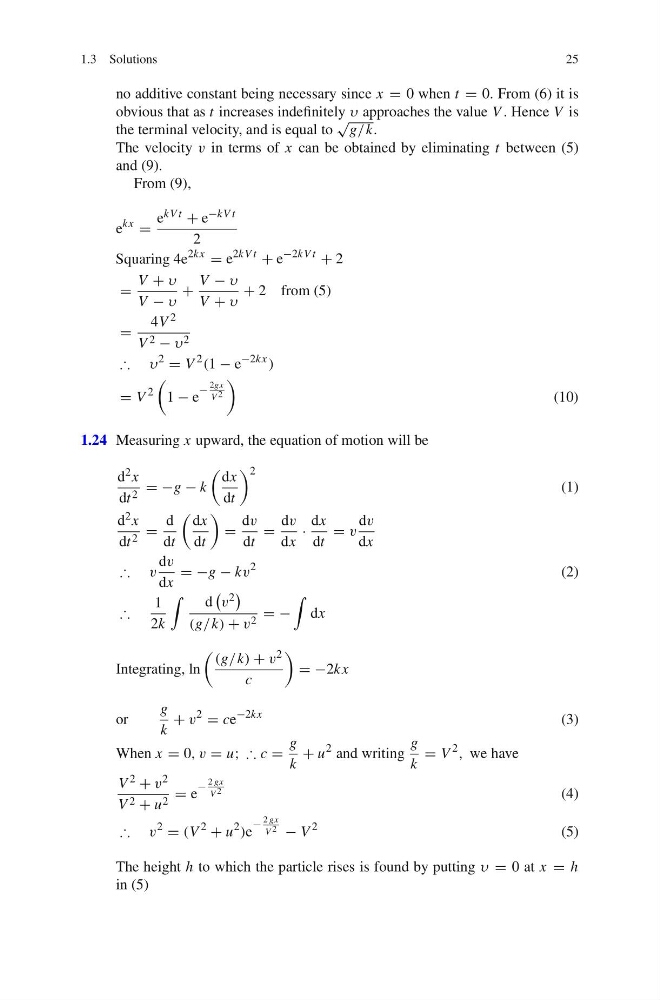
no additive constant being necessary since x = 0 when t = 0. From (6) it is
obvious that as t increases indefinitely υ approaches the value V . Hence V is
the terminal velocity, and is equal to
√
g/k.
The velocity v in terms of x can be obtained by eliminating t between (5)
and (9).
From (9),
e
kx
=
e kV t + e −kV t
2
Squaring 4e
2kx
= e
2kV t
+ e
−2kV t
+ 2
=
V + υ
V − υ
+
V − υ
V + υ
+ 2 from (5)
=
4V 2
V 2 − υ 2
∴ υ
2
= V
2
(1 − e
−2kx
)
= V
2
1 − e
−
2gx
V 2
(10)
1.24 Measuring x upward, the equation of motion will be
d 2 x
dt 2 = −g − k
dx
dt
2
(1)
d 2 x
dt 2 =
d
dt
dx
dt
=
dv
dt
=
dv
dx
·
dx
dt
= v
dv
dx
∴ v
dv
dx
= −g − kv
2
(2)
∴
1
2k
d
v 2
(g/k) + v 2 = −
dx
Integrating, ln
(g/k) + v 2
c
= −2kx
or
g
k
+ v
2
= ce
−2kx
(3)
When x = 0, v = u; ∴ c =
g
k
+ u
2 and writing
g
k
= V
2
, we have
V 2 + v 2
V 2 + u 2 = e
−
2 gx
V 2
(4)
∴ v
2
= (V
2
+ u
2
)e
−
2 gx
V 2 − V
2
(5)
The height h to which the particle rises is found by putting υ = 0 at x = h
in (5)
25
no additive constant being necessary since x = 0 when t = 0. From (6) it is
obvious that as t increases indefinitely υ approaches the value V . Hence V is
the terminal velocity, and is equal to
√
g/k.
The velocity v in terms of x can be obtained by eliminating t between (5)
and (9).
From (9),
e
kx
=
e kV t + e −kV t
2
Squaring 4e
2kx
= e
2kV t
+ e
−2kV t
+ 2
=
V + υ
V − υ
+
V − υ
V + υ
+ 2 from (5)
=
4V 2
V 2 − υ 2
∴ υ
2
= V
2
(1 − e
−2kx
)
= V
2
1 − e
−
2gx
V 2
(10)
1.24 Measuring x upward, the equation of motion will be
d 2 x
dt 2 = −g − k
dx
dt
2
(1)
d 2 x
dt 2 =
d
dt
dx
dt
=
dv
dt
=
dv
dx
·
dx
dt
= v
dv
dx
∴ v
dv
dx
= −g − kv
2
(2)
∴
1
2k
d
v 2
(g/k) + v 2 = −
dx
Integrating, ln
(g/k) + v 2
c
= −2kx
or
g
k
+ v
2
= ce
−2kx
(3)
When x = 0, v = u; ∴ c =
g
k
+ u
2 and writing
g
k
= V
2
, we have
V 2 + v 2
V 2 + u 2 = e
−
2 gx
V 2
(4)
∴ v
2
= (V
2
+ u
2
)e
−
2 gx
V 2 − V
2
(5)
The height h to which the particle rises is found by putting υ = 0 at x = h
in (5)