

392
9 Fluid Dynamics
constant. At two points 1 and 2,
ρ 1 A 1 v 1 = ρ 2 A 2 v 2 = constant (one-dimensional flow)
(9.2)
For incompressible fluids, ρ 1 = ρ 2 , and (9.2) is reduced to
Q = A 1 v 1 = A 2 v 2 = constant
(9.3)
∇.ρv +
∂ρ
∂t
= 0
(equation of continuity in three dimensions)
(9.4)
For steady incompressible flow, ρ = constant and (9.4) reduces to
∂v x
∂ x
+
∂v y
∂ y
+
∂v z
∂z
= 0
(9.5)
Bernoulli’s equation for steady, non-viscous, incompressible flow
p
ρ
+ gh +
1
2
v
2
= constant
(9.6)
or P + ρgh +
1
2
ρv
2
= constant
(9.7)
In (9.6) the first term P/ρ is the pressure head or the potential energy per unit mass
of the liquid due to the pressure, the second term hg is the elevation head or the
potential energy per unit mass of the liquid due to gravity and the third term v 2 /2
is the kinetic energy per unit mass of the liquid. Thus, Bernoulli’s equation results
from the conservation of energy.
Torricelli’s theorem: A tank is filled with a liquid. An orifice is located at the
side of the tank, at a depth h below the surface of the liquid. Then the velocity of
emergence of the liquid from the orifice is given by
v =
2gh
(9.8)
The venturi meter: It works as a gauge to measure the flow speed of a liquid. Let a
liquid of density ρ flow through a pipe of cross-sectional area A with velocity v. At
the constriction, called throat, the area is reduced to a (Fig. 9.1). A manometer containing a suitable liquid of density serves to register the pressure difference between
points 1 and 2. In Bernoulli’s equation the gravitational energy term will be absent
as the centre of the cross-sectional areas A and a is at the same horizontal level.
Finally, we obtain
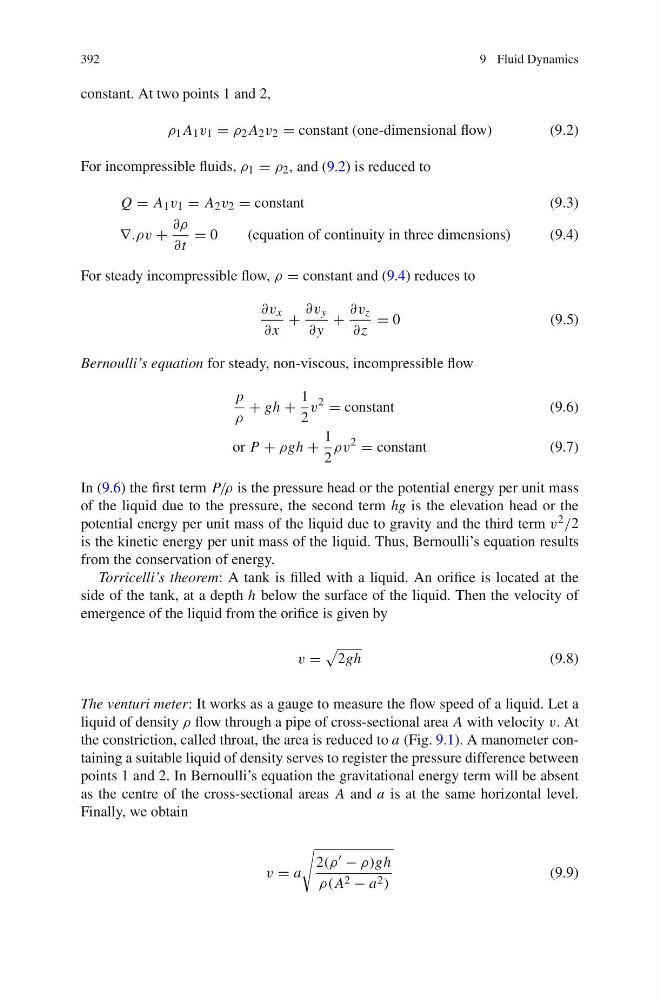
v = a
2(ρ − ρ)gh
ρ(A 2 − a 2 )
(9.9)
9 Fluid Dynamics
constant. At two points 1 and 2,
ρ 1 A 1 v 1 = ρ 2 A 2 v 2 = constant (one-dimensional flow)
(9.2)
For incompressible fluids, ρ 1 = ρ 2 , and (9.2) is reduced to
Q = A 1 v 1 = A 2 v 2 = constant
(9.3)
∇.ρv +
∂ρ
∂t
= 0
(equation of continuity in three dimensions)
(9.4)
For steady incompressible flow, ρ = constant and (9.4) reduces to
∂v x
∂ x
+
∂v y
∂ y
+
∂v z
∂z
= 0
(9.5)
Bernoulli’s equation for steady, non-viscous, incompressible flow
p
ρ
+ gh +
1
2
v
2
= constant
(9.6)
or P + ρgh +
1
2
ρv
2
= constant
(9.7)
In (9.6) the first term P/ρ is the pressure head or the potential energy per unit mass
of the liquid due to the pressure, the second term hg is the elevation head or the
potential energy per unit mass of the liquid due to gravity and the third term v 2 /2
is the kinetic energy per unit mass of the liquid. Thus, Bernoulli’s equation results
from the conservation of energy.
Torricelli’s theorem: A tank is filled with a liquid. An orifice is located at the
side of the tank, at a depth h below the surface of the liquid. Then the velocity of
emergence of the liquid from the orifice is given by
v =
2gh
(9.8)
The venturi meter: It works as a gauge to measure the flow speed of a liquid. Let a
liquid of density ρ flow through a pipe of cross-sectional area A with velocity v. At
the constriction, called throat, the area is reduced to a (Fig. 9.1). A manometer containing a suitable liquid of density serves to register the pressure difference between
points 1 and 2. In Bernoulli’s equation the gravitational energy term will be absent
as the centre of the cross-sectional areas A and a is at the same horizontal level.
Finally, we obtain
v = a
2(ρ − ρ)gh
ρ(A 2 − a 2 )
(9.9)