

8.3 Solutions
383
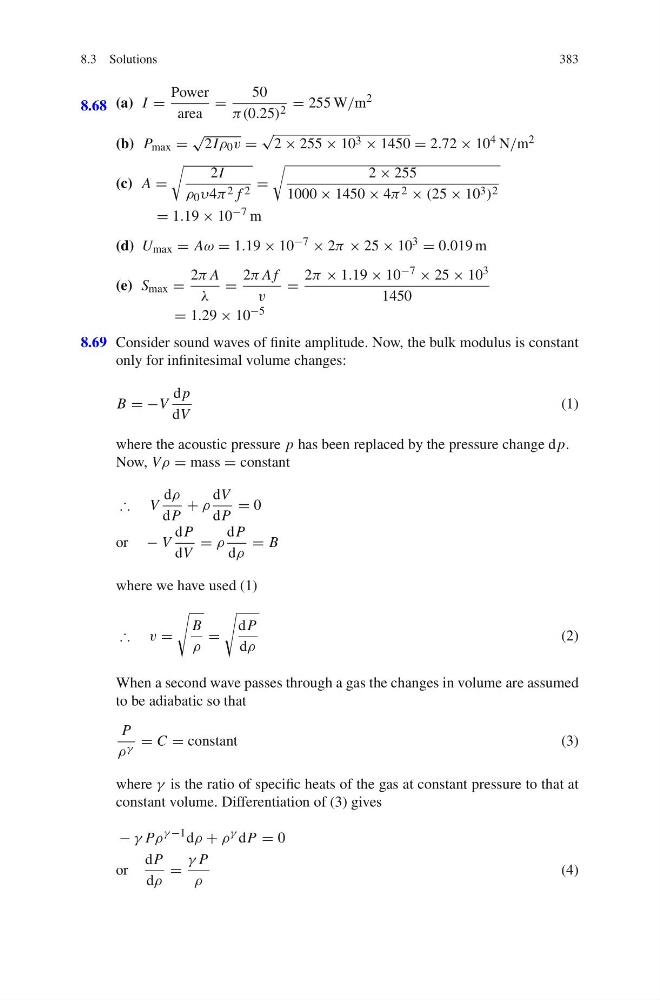
8.68 (a) I =
Power
area
=
50
π(0.25) 2 = 255 W/m 2
(b) P max =
√
2Iρ 0 v =
√
2 × 255 × 10 3 × 1450 = 2.72 × 10 4 N/m 2
(c) A =
2I
ρ 0 υ4π 2 f 2 =
2 × 255
1000 × 1450 × 4π 2 × (25 × 10 3 ) 2
= 1.19 × 10 −7 m
(d) U max = Aω = 1.19 × 10 −7 × 2π × 25 × 10 3 = 0.019 m
(e) S max =
2π A
λ
=
2π A f
v
=
2π × 1.19 × 10 −7 × 25 × 10 3
1450
= 1.29 × 10 −5
8.69 Consider sound waves of finite amplitude. Now, the bulk modulus is constant
only for infinitesimal volume changes:
B = −V
d p
dV
(1)
where the acoustic pressure p has been replaced by the pressure change d p.
Now, Vρ = mass = constant
∴ V
dρ
dP
+ ρ
dV
dP
= 0
or − V
dP
dV
= ρ
dP
dρ
= B
where we have used (1)
∴ v =
B
ρ
=
dP
dρ
(2)
When a second wave passes through a gas the changes in volume are assumed
to be adiabatic so that
P
ρ γ = C = constant
(3)
where γ is the ratio of specific heats of the gas at constant pressure to that at
constant volume. Differentiation of (3) gives
− γ Pρ
γ −1 dρ + ρ
γ dP = 0
or
dP
dρ
=
γ P
ρ
(4)
383
8.68 (a) I =
Power
area
=
50
π(0.25) 2 = 255 W/m 2
(b) P max =
√
2Iρ 0 v =
√
2 × 255 × 10 3 × 1450 = 2.72 × 10 4 N/m 2
(c) A =
2I
ρ 0 υ4π 2 f 2 =
2 × 255
1000 × 1450 × 4π 2 × (25 × 10 3 ) 2
= 1.19 × 10 −7 m
(d) U max = Aω = 1.19 × 10 −7 × 2π × 25 × 10 3 = 0.019 m
(e) S max =
2π A
λ
=
2π A f
v
=
2π × 1.19 × 10 −7 × 25 × 10 3
1450
= 1.29 × 10 −5
8.69 Consider sound waves of finite amplitude. Now, the bulk modulus is constant
only for infinitesimal volume changes:
B = −V
d p
dV
(1)
where the acoustic pressure p has been replaced by the pressure change d p.
Now, Vρ = mass = constant
∴ V
dρ
dP
+ ρ
dV
dP
= 0
or − V
dP
dV
= ρ
dP
dρ
= B
where we have used (1)
∴ v =
B
ρ
=
dP
dρ
(2)
When a second wave passes through a gas the changes in volume are assumed
to be adiabatic so that
P
ρ γ = C = constant
(3)
where γ is the ratio of specific heats of the gas at constant pressure to that at
constant volume. Differentiation of (3) gives
− γ Pρ
γ −1 dρ + ρ
γ dP = 0
or
dP
dρ
=
γ P
ρ
(4)