

8.3 Solutions
379
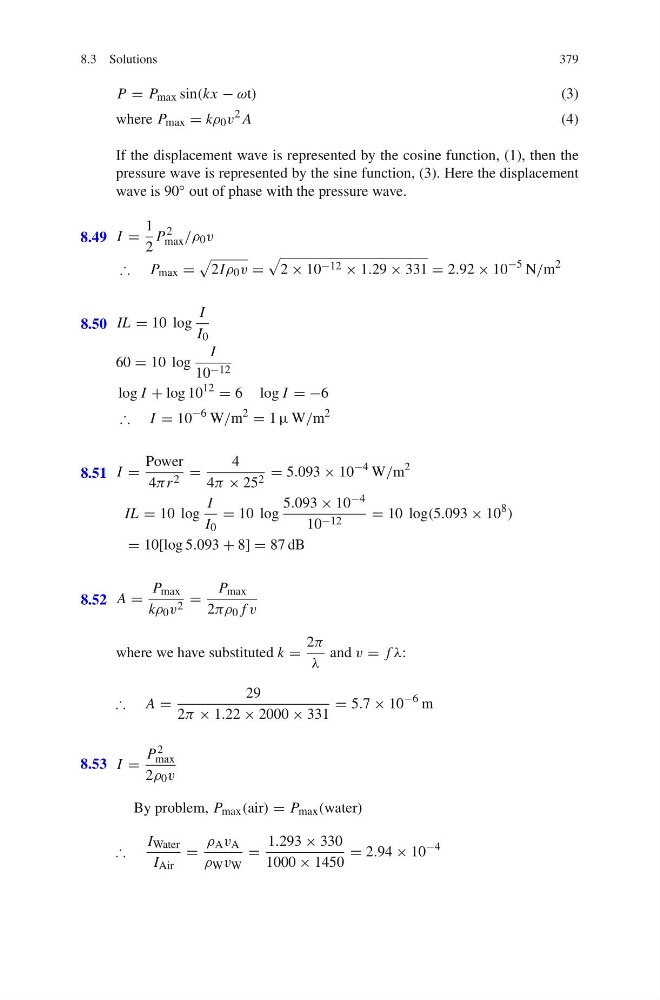
P = P max sin(kx − ωt)
(3)
where P max = kρ 0 v
2 A
(4)
If the displacement wave is represented by the cosine function, (1), then the
pressure wave is represented by the sine function, (3). Here the displacement
wave is 90 ◦ out of phase with the pressure wave.
8.49 I =
1
2
P
2
max /ρ 0 v
∴ P max =
2Iρ 0 v =
2 × 10 −12 × 1.29 × 331 = 2.92 × 10
−5 N/m
2
8.50 IL = 10 log
I
I 0
60 = 10 log
I
10 −12
log I + log 10
12
= 6 log I = −6
∴ I = 10
−6 W/m
2
= 1 μ W/m
2
8.51 I =
Power
4πr 2 =
4
4π × 25 2 = 5.093 × 10
−4 W/m
2
IL = 10 log
I
I 0
= 10 log
5.093 × 10 −4
10 −12
= 10 log(5.093 × 10
8
)
= 10[log 5.093 + 8] = 87 dB
8.52 A =
P max
kρ 0 v 2 =
P max
2πρ 0 f v
where we have substituted k =
2π
λ
and v = f λ:
∴ A =
29
2π × 1.22 × 2000 × 331
= 5.7 × 10
−6 m
8.53 I =
P 2
max
2ρ 0 v
By problem, P max (air) = P max (water)
∴
I Water
I Air
=
ρ A v A
ρ W v W
=
1.293 × 330
1000 × 1450
= 2.94 × 10
−4
379
P = P max sin(kx − ωt)
(3)
where P max = kρ 0 v
2 A
(4)
If the displacement wave is represented by the cosine function, (1), then the
pressure wave is represented by the sine function, (3). Here the displacement
wave is 90 ◦ out of phase with the pressure wave.
8.49 I =
1
2
P
2
max /ρ 0 v
∴ P max =
2Iρ 0 v =
2 × 10 −12 × 1.29 × 331 = 2.92 × 10
−5 N/m
2
8.50 IL = 10 log
I
I 0
60 = 10 log
I
10 −12
log I + log 10
12
= 6 log I = −6
∴ I = 10
−6 W/m
2
= 1 μ W/m
2
8.51 I =
Power
4πr 2 =
4
4π × 25 2 = 5.093 × 10
−4 W/m
2
IL = 10 log
I
I 0
= 10 log
5.093 × 10 −4
10 −12
= 10 log(5.093 × 10
8
)
= 10[log 5.093 + 8] = 87 dB
8.52 A =
P max
kρ 0 v 2 =
P max
2πρ 0 f v
where we have substituted k =
2π
λ
and v = f λ:
∴ A =
29
2π × 1.22 × 2000 × 331
= 5.7 × 10
−6 m
8.53 I =
P 2
max
2ρ 0 v
By problem, P max (air) = P max (water)
∴
I Water
I Air
=
ρ A v A
ρ W v W
=
1.293 × 330
1000 × 1450
= 2.94 × 10
−4