

340
8 Waves
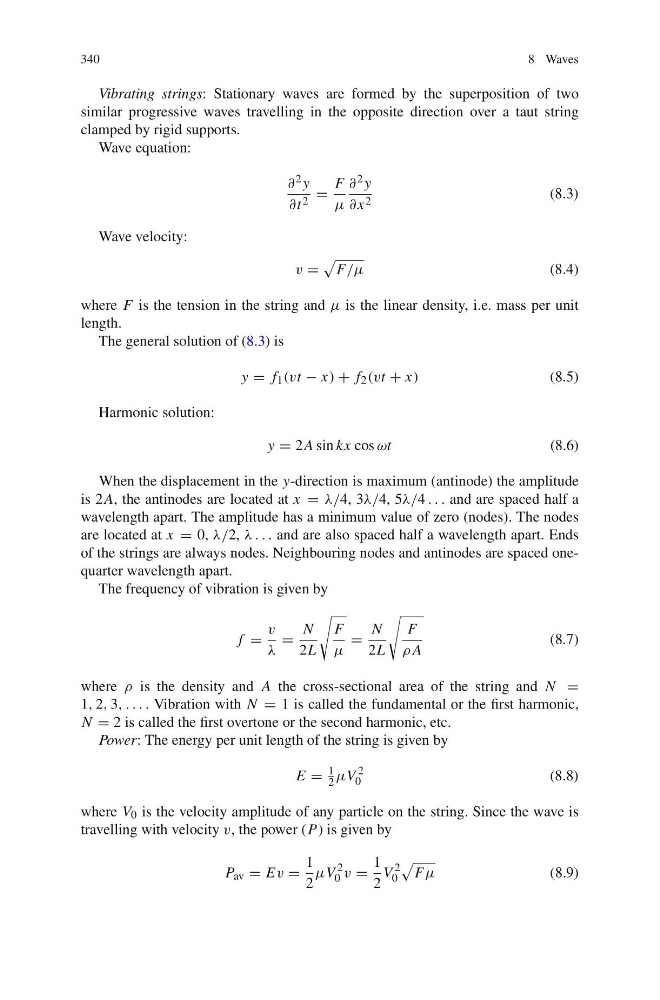
Vibrating strings: Stationary waves are formed by the superposition of two
similar progressive waves travelling in the opposite direction over a taut string
clamped by rigid supports.
Wave equation:
∂ 2 y
∂t 2 =
F
μ
∂ 2 y
∂ x 2
(8.3)
Wave velocity:
v =
F/μ
(8.4)
where F is the tension in the string and μ is the linear density, i.e. mass per unit
length.
The general solution of (8.3) is
y = f 1 (vt − x) + f 2 (vt + x)
(8.5)
Harmonic solution:
y = 2A sin kx cos ωt
(8.6)
When the displacement in the y-direction is maximum (antinode) the amplitude
is 2A, the antinodes are located at x = λ/4, 3λ/4, 5λ/4 . . . and are spaced half a
wavelength apart. The amplitude has a minimum value of zero (nodes). The nodes
are located at x = 0, λ/2, λ . . . and are also spaced half a wavelength apart. Ends
of the strings are always nodes. Neighbouring nodes and antinodes are spaced onequarter wavelength apart.
The frequency of vibration is given by
f =
v
λ
=
N
2L
F
μ
=
N
2L
F
ρ A
(8.7)
where ρ is the density and A the cross-sectional area of the string and N =
1, 2, 3, . . . . Vibration with N = 1 is called the fundamental or the first harmonic,
N = 2 is called the first overtone or the second harmonic, etc.
Power: The energy per unit length of the string is given by
E =
1
2 μV
2
0
(8.8)
where V 0 is the velocity amplitude of any particle on the string. Since the wave is
travelling with velocity v, the power (P) is given by
P av = Ev =
1
2
μV
2
0 v =
1
2
V
2
0
Fμ
(8.9)
8 Waves
Vibrating strings: Stationary waves are formed by the superposition of two
similar progressive waves travelling in the opposite direction over a taut string
clamped by rigid supports.
Wave equation:
∂ 2 y
∂t 2 =
F
μ
∂ 2 y
∂ x 2
(8.3)
Wave velocity:
v =
F/μ
(8.4)
where F is the tension in the string and μ is the linear density, i.e. mass per unit
length.
The general solution of (8.3) is
y = f 1 (vt − x) + f 2 (vt + x)
(8.5)
Harmonic solution:
y = 2A sin kx cos ωt
(8.6)
When the displacement in the y-direction is maximum (antinode) the amplitude
is 2A, the antinodes are located at x = λ/4, 3λ/4, 5λ/4 . . . and are spaced half a
wavelength apart. The amplitude has a minimum value of zero (nodes). The nodes
are located at x = 0, λ/2, λ . . . and are also spaced half a wavelength apart. Ends
of the strings are always nodes. Neighbouring nodes and antinodes are spaced onequarter wavelength apart.
The frequency of vibration is given by
f =
v
λ
=
N
2L
F
μ
=
N
2L
F
ρ A
(8.7)
where ρ is the density and A the cross-sectional area of the string and N =
1, 2, 3, . . . . Vibration with N = 1 is called the fundamental or the first harmonic,
N = 2 is called the first overtone or the second harmonic, etc.
Power: The energy per unit length of the string is given by
E =
1
2 μV
2
0
(8.8)
where V 0 is the velocity amplitude of any particle on the string. Since the wave is
travelling with velocity v, the power (P) is given by
P av = Ev =
1
2
μV
2
0 v =
1
2
V
2
0
Fμ
(8.9)