

7.3 Solutions
331
Using (6) and (8) in (5)
¨
r =
rc 2
r 4 − g =
a 3 g
r 3 − g
(9)
(c) (i) Since Q does not move, P must be at constant distance r = a from
the opening. Therefore P describes a circle of constant radius a.
(ii) Let P be displaced by a small distance x from the stable circular orbit
of radius a, that is
r = a + x
(10)
∴ ¨
r = ¨
x
(11)
Using (10) and (11) in (9)
¨
x = g
a 3
(a + x) 3 − 1
= g
1 +
x
a
−3 − 1
or ¨
x −
3gx
a
or ¨
x +
3gx
a
= 0
(12)
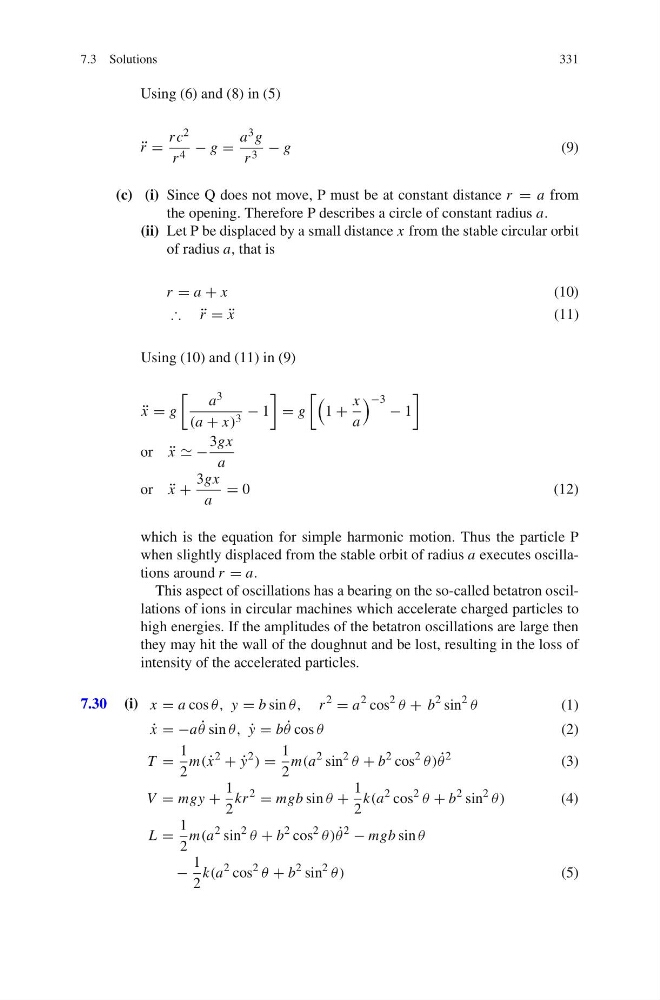
which is the equation for simple harmonic motion. Thus the particle P
when slightly displaced from the stable orbit of radius a executes oscillations around r = a.
This aspect of oscillations has a bearing on the so-called betatron oscillations of ions in circular machines which accelerate charged particles to
high energies. If the amplitudes of the betatron oscillations are large then
they may hit the wall of the doughnut and be lost, resulting in the loss of
intensity of the accelerated particles.
7.30 (i) x = a cos θ, y = b sin θ, r
2
= a
2 cos
2
θ + b
2 sin
2
θ
(1)
˙
x = −a ˙
θ sin θ, ˙
y = b ˙
θ cos θ
(2)
T =
1
2
m( ˙
x
2
+ ˙
y
2
) =
1
2
m(a
2 sin
2
θ + b
2 cos
2
θ) ˙
θ
2
(3)
V = mgy +
1
2
kr
2
= mgb sin θ +
1
2
k(a
2 cos
2
θ + b
2 sin
2
θ)
(4)
L =
1
2
m(a
2 sin
2
θ + b
2 cos
2
θ) ˙
θ
2
− mgb sin θ
−
1
2
k(a
2 cos
2
θ + b
2 sin
2
θ)
(5)
331
Using (6) and (8) in (5)
¨
r =
rc 2
r 4 − g =
a 3 g
r 3 − g
(9)
(c) (i) Since Q does not move, P must be at constant distance r = a from
the opening. Therefore P describes a circle of constant radius a.
(ii) Let P be displaced by a small distance x from the stable circular orbit
of radius a, that is
r = a + x
(10)
∴ ¨
r = ¨
x
(11)
Using (10) and (11) in (9)
¨
x = g
a 3
(a + x) 3 − 1
= g
1 +
x
a
−3 − 1
or ¨
x −
3gx
a
or ¨
x +
3gx
a
= 0
(12)
which is the equation for simple harmonic motion. Thus the particle P
when slightly displaced from the stable orbit of radius a executes oscillations around r = a.
This aspect of oscillations has a bearing on the so-called betatron oscillations of ions in circular machines which accelerate charged particles to
high energies. If the amplitudes of the betatron oscillations are large then
they may hit the wall of the doughnut and be lost, resulting in the loss of
intensity of the accelerated particles.
7.30 (i) x = a cos θ, y = b sin θ, r
2
= a
2 cos
2
θ + b
2 sin
2
θ
(1)
˙
x = −a ˙
θ sin θ, ˙
y = b ˙
θ cos θ
(2)
T =
1
2
m( ˙
x
2
+ ˙
y
2
) =
1
2
m(a
2 sin
2
θ + b
2 cos
2
θ) ˙
θ
2
(3)
V = mgy +
1
2
kr
2
= mgb sin θ +
1
2
k(a
2 cos
2
θ + b
2 sin
2
θ)
(4)
L =
1
2
m(a
2 sin
2
θ + b
2 cos
2
θ) ˙
θ
2
− mgb sin θ
−
1
2
k(a
2 cos
2
θ + b
2 sin
2
θ)
(5)